Webomates provides a cloud-based AI software testing as a service platform to carry out software functional testing in guaranteed timeframes. The platform creates test cases & scripts and executes them using multiple testing execution techniques like AI Automation, Automation, Crowdsource & AI enhanced manual. At the end of the execution what you get is the actionable triaged defects. Every execution result is recorded and auditable from the CQ portal.
Smoke testing is a preparatory testing handle to check whether the fundamental functionalities of a program application are working accurately. It acts as a litmus test to guarantee that the center highlights a program run as anticipated some time recently more point-by-point testing has been carried out. Regularly alluded to as "construct confirmation testing," it makes a difference in recognizing major issues early in the advancement cycle, sparing time and assets. By centering on the most basic viewpoints of an application, smoke testing permits engineers to affirm solidness and usefulness some sometimes recently continuing to more thorough testing stages. This hone is pivotal in ceaseless integration situations, guaranteeing that unused code changes do not disturb existing usefulness. In general, smoke testing gives a fast, proficient way to approve computer program builds.
The dawn of Generative AI marks the beginning of a new era, much like the rise of the Force wielders in the Star Wars galaxy. Applications such as ChatGPT, GitHub Copilot, and DeepArt have sparked a revolution, unleashing a wave of innovation and productivity that was once unimaginable.
Generative AI possesses the ability to mimic human capabilities to an astounding degree, leading some to fear its potential to replace humans. However, it’s crucial to recognize that Generative AI is meant to empower rather than replace humans.
Leaders in various organizations are realizing that by fostering collaboration between humans and Generative AI, they can achieve extraordinary feats.
So, what are the potential benefits of this collaboration for businesses?
Generative AI Use Cases
Imagine a scenario where a software application for a galactic banking platform needs testing. Let’s explore how Generative AI can streamline manual efforts, expedite testing cycles, and enhance efficiency across various use cases.
Test Case and Data Generation
Generative AI can assist in generating comprehensive test cases by analyzing application requirements and existing code. It can cover positive and negative scenarios, as well as edge cases.
For the banking application, it can generate test cases for tasks like creating new accounts, transferring funds between different account types, and testing transaction limits. It can create sample customer account details, names, addresses, and other necessary data.
Code Completion
Generative AI can provide developers with recommendations and code snippets to speed up coding tasks. By understanding code semantics and structure, it offers accurate suggestions.
Examples include CodeAI and GitHub’s CoPilot, which utilize contextual understanding and trained models to accelerate coding processes.
Code Optimization
Generative AI algorithms can analyze code to identify performance bottlenecks and propose code refactoring suggestions. For instance, it can pinpoint inefficient algorithms or resource usage, offering alternative implementations to improve execution speed.
Defect Identification and Prediction
Generative AI aids in identifying coding errors and deviations from standards. By learning from previous defects, it can detect patterns and predict potential defects. For example, Webomates’ AI Defect Predictor helps reduce triage time for development and QA teams, enabling proactive defect correction.
Documentation Generation
Generative AI automates the documentation process by extracting data from code, test cases, and other resources. Accenture is exploring the use of OpenAI LLMs to automatically generate documentation, saving time and effort for developers and testers.
How can Webomates Help?
Generative AI is a powerful ally in software testing and automation efforts, akin to the Force in the Star Wars saga. Webomates offers AI-driven testing solutions to optimize testing across various scenarios.
Schedule a demo to unlock the full potential of our AI-driven software testing solutions, which can enhance productivity, accelerate product releases, and propel your business forward. Contact us at info@webomates.com to learn more.
Generative AI, is the latest buzzword emerging among organizations to enhance productivity and innovation.
Also referred as Generative AI, it expands the capabilities of AI by enabling applications to analyze existing data and create new data that can be in the form of text, images, audio, and video.
It uses ML algorithms to train models to understand patterns and data.
In order to provide a better customer experience, teams are increasingly beginning to use the power of generative AI by integrating ML and AI throughout their technology stack.
As per the Generative AI market report, it is anticipated to soar from a USD 8.65 billion valuation in 2022 to a whopping USD 188.62 billion by 2032.
In this article, we explore the transformative impact of Generative AI on QA cost management.
How Does Generative AI empower QA teams?
For every team, there is always one ongoing challenge: how to ensure comprehensive testing while enhancing the quality assurance (QA) capabilities.
Traditional AI systems are programmed to perform specific tasks. Generative ai in software testing relies on models and algorithms that pick up patterns from vast amounts of datasets, and then generate new content and make new predictions.
Great!! How are you tracking and documenting your current results?
I have resources and means to do that.
Nice!! But, what are the key metrics that you are prioritizing?
To be honest, we end up creating a generic report many times. Can you help?
Well, there are so many such questions that you have to answer because testing doesn’t end with setting up the automation, it needs to be properly tracked and reported. These insights further help you with the thorough and quick decision making process. However, manually gathering these reports, analyzing and creating dashboards is a time taking process and this is where AI steps in.
But before we start talking about AI in test reporting and analysis, let’s quickly recap the value of reporting and analysis in software testing.
What Is a Test Automation Report?
Test automation is like a blueprint that shows the results of your test execution. It shows you the number of tests executed, the details of those tests, execution time, steps that passed, failed or skipped due to whatever reason. These reports encapsulate the entire process in numbers to make you understand and provide you with smart insights.
Importance of Test Automation Reporting
Test automation reporting serves as a transparent documentation of test outcomes, allowing teams to make data-driven decisions and ensure the efficiency and reliability of their software. These reports offer real-time visibility into testing progress, enabling quick issue identification and resolution. By presenting actionable metrics, they empower teams to optimize resources, make informed decisions, and instill confidence in clients and stakeholders.
Traditional Reporting Challenges
Limited Insights: Traditional reporting often provides only surface-level information, leaving stakeholders with limited insights into the true health of the project.
Manual Effort: The manual compilation of test data and generation of reports consumes valuable time and resources, hindering efficiency.
Data Overload: Drowning in a sea of data, it becomes tough for stakeholders to extract meaningful information from overwhelming test reports.
Static Reporting: Static reports lack real-time updates, limiting their relevance and making them less adaptable to dynamic project changes.
Lack of Context: Reports without contextual information leave stakeholders guessing about the significance of the presented data.
Ineffective Communication: Poorly presented information fails to convey the testing story, leading to misunderstandings among team members.
Reactive Approach: Traditional reporting tends to be reactive, addressing issues only after they’ve occurred, rather than proactively preventing them.
Complex Test Environment: Understanding and interpreting reports become more challenging, leading to confusion.
The Role of AI in Test Automation Reporting
Leveraging AI in test automation reporting can simplify the entire process and give you in-depth insights.
Smart Analytics and Insights:
AI, armed with machine learning algorithms, reshapes how we interpret test data. By delving deep into the intricacies, it provides nuanced insights, enabling a comprehensive understanding of software quality. Identifying patterns, trends, and anomalies becomes not just a possibility but a forte of AI-driven analysis. Read for more about this blog : Test Automation Reporting
Technology is the primary force behind any transformation. And the role of testing is changing, moving from being overlooked to becoming a value creator. In today’s world, it becomes extremely critical for enterprises to adapt to the fast-changing requirements and customer expectations.
Test Automation plays an important role in allowing businesses to boost productivity, develop new products rapidly, and enhance the development and testing process thereby leading to increased customer experience.
Many teams use Open-source platforms for their test automation. Although such platforms offer extensive customization, flexibility, and a broader community ecosystem, it’s essential to recognize the potential bottlenecks associated with them.
Bottlenecks of open source platforms:
Requires a higher degree of proficiency in programming languages and frameworks.
Creating and maintaining tests is time-consuming, especially for complex applications with frequent changes.
Flaky tests along with factors such as synchronization issues, dynamic content, or environmental variations can contribute to the instability of tests.
Open-source tools may require dedicated resources for script development, leading to higher costs.
Scaling test automation efforts with open source tools is challenging especially when the application’s functionalities increase, leading to increased complexity.
Test scripts in open-source tools may lack reusability.
Developers need a lot of hands-on experience with programming languages before they can be productive.
Development of applications takes more time.
Shifting to low code/no code platforms can offer a more accessible and efficient testing process, especially for teams looking to enhance collaboration and accelerate testing cycles.
Transforming the testing landscape with LC/NC platforms
Low-Code platforms, also known as low-code application development platforms, minimize or eliminate the manual coding required to develop and deploy software applications. They have a panel of visual elements that enable development without programming.
No-Code platforms allow people with no knowledge or technical training in software development to create applications without programming a single line of code.
Teams can use Low-Code/No-Code (LCNC) technologies to radically change how work gets done. It can enable teams to automate more tedious, error-prone processes that can occasionally take attention away from more strategic, higher-level work that adds greater value to the company.
According to the Mckinsey report, there will be 70% growth in the market and adoption of new application development that will leverage low-code/no code by 2025 (vs <25% in 2020).
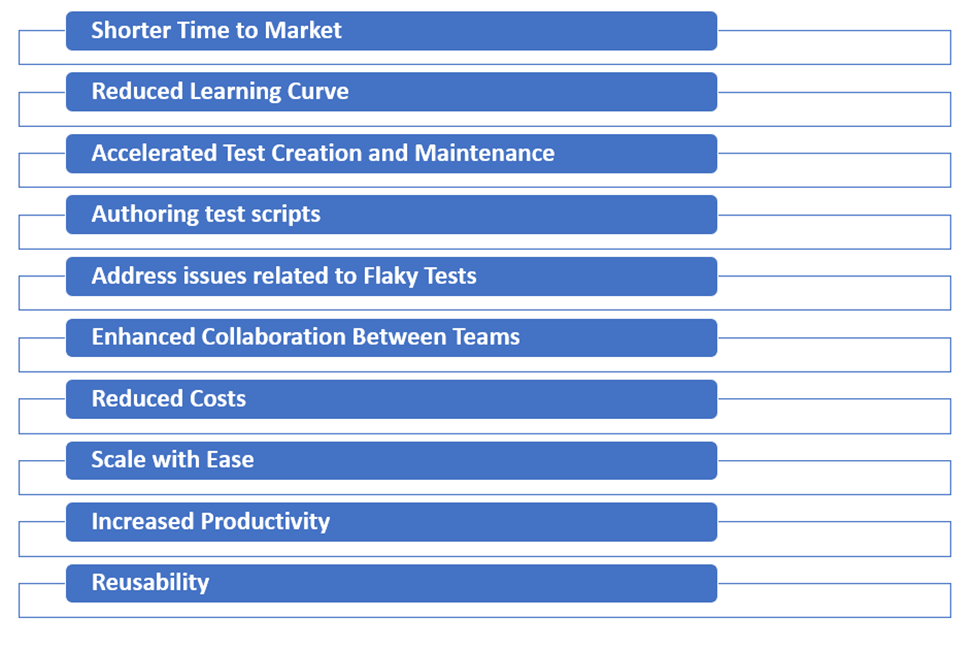
Benefits of Low-Code/ No-Code Platforms
1.Shorter Time to Market
Less time is spent on development using such platforms. With code templates and pre-built features, you can significantly improve your application’s release time, resulting in a shorter time to market for new products. significantly
2.Reduced Learning Curve
It requires minimal coding experience and provides a visual interface and pre-built components making it easy to use. Using a component-based approach enables developers to develop applications without writing any code.
3.Accelerated Test Creation and Maintenance
Creating and maintaining tests is faster due to the drag-and-drop functionality and reusable components. This will ensure testing cycles are much faster compared to traditional test automation.
4.Authoring test scripts
Offers a visual interface and drag-and-drop functionality, reducing the time and effort required to author test cases.
5.Address issues related to Flaky Tests
The LC/NC platforms minimize the reliance on intricate coding and have features for handling dynamic elements and reducing the flaky tests. You can have AI-powered automation with self-healing capability to deal with synchronization issues or dynamic elements.
6.Enhanced Collaboration Between Teams
Quality increases when teams work together. These platforms encourage collaboration by allowing business analysts and testers to contribute to test automation efforts from very early stages, making the development and testing cycles more agile and focused on the end-user experience.
7.Reduced Costs
You can reduce the dependency of developers in creating UI tests. Testers can also contribute to automation, reducing the need for specialized development skills and associated costs of training.
8.Scale with Ease
These tools can handle complex test scenarios and also scale up or down according to the changing needs of the testing process.
9.Increased Productivity
Rather than spending hours coding, developers can be productive by focusing on more important business problems.
10.Reusability
These platforms emphasize on modular designs, allowing developers/testers to create reusable components. You can reuse the test flows across test plans. To know more about this blog : Benefits of low code test automation
Automation “executes”. Intelligent automation “thinks” and “learns”.
The tricky question of thorough testing needs to be addressed in a holistic and procedural manner. It’s good to have a great testing strategy on paper, but it’s even more important to properly execute and this is certainly not a walk in the park. Many businesses still grapple with the consequences of not implementing it.
In today’s digital age, where almost all businesses are digital, teams face intense competition to deliver innovative features swiftly and securely. With the urgency to deliver features with limited time, teams often focus on short-term product success over long-term in-depth testing benefits. This trade-off can have consequences, including software defects, security vulnerabilities, and dissatisfied users.
A proper intelligent testing automation strategy must be backed by a well-defined delivery structure, a balanced mix of technology enablers, and on-demand access to tools, technologies, test environments, and frameworks.
Critical Business Challenges
Let’s consider a banking application, and see how Intelligent test automation leverages artificial intelligence (AI) and machine learning (ML) technologies to streamline the testing process and address critical business problems.
1.Delayed Time to Market
Scenario: A banking application must update its mobile app to include a new payment feature.
Pain Point: With traditional ways of identifying defects at the last stages, there is less time to fix defects, thereby increasing the likelihood that they will be postponed until later increments or versions of the system, thus creating a “bow wave” of technical debt.
This can significantly delay product launches.
Solution:Shift Left Testing involves testing the application right from the beginning of the development process. Additionally, teams can fix defects in regression tests quickly with runtime Self-healing capability. Tools like the AI Defect Predictor tool help you to accelerate defect prediction and resolution, allowing teams to go to market with releases faster.
2.Decreased Software Quality due to Frequent Code Changes
Scenario: The development team keeps updating the application’s code due to changing requirements, security updates, defect fixes, code refactoring, or performance optimization.
Pain Point: Frequent code changes can introduce new defects. The teams struggle with a rapid development pace with minimum testing.
Solution: Intelligent Automation testing integrates into CI/CD pipelines, ensuring complete testing prior to the release. As per the scope of the build, you can scale up by getting build checks done via the 3 types of regression testing services, where the regression cycles are reduced from weeks to just hours.
CI/CD — 15 mins to 1 hour
Overnight with Exploratory — 8 hours
Full with Exploratory — 24 hours
3. Lack of Testing Insights
Scenario: There is a specific defect pattern that keeps occurring in the application leading to similar issues and downtime.
Pain Point: Lack of data-driven insights impacts efficiency and leads to lower customer experience (CX). True intelligence starts when you can make intelligent decisions on demand.
Solution: AI thrives on information. It has the ability to collect and analyze data in real time. With test insights into the entire CI/CD pipeline, you can understand the effect of each change on the product, and their patterns and ultimately develop better customer experience strategies.
4. Security Vulnerabilities
Scenario: Your application collects enormous amounts of personally identifiable information and hence could be targeted by cyber criminals.
Pain Point: Misuse of data and unauthorized use of AI can have a negative impact on the business. Such malicious attacks could result in expensive lawsuits, penalties, and reputational damage.
Solution: When creating your applications, it’s critical to take end users’ privacy, transparency, and security issues into consideration. Conducting in-depth Performance Testing and Security testing ensures that the application does not have any web vulnerability that could potentially expose any sensitive data to an intruder or an attacker. Read for more click here : Transforming 6 Business Challenges into Smart Solutions