Showing posts with label Intelligent automation. Show all posts

Thursday, January 11, 2024

10 Lifesaving AI Uses Every Developer/Tester Should Know


Software and applications have become an integral part of every industry. According to Statista Market Insights, “The world software revenue was estimated to be around $659Bn in 2023.”

As good as it sounds, this major surge in software or application requirements has made it difficult for software teams to focus on quality and speed at the same time and this is when AI comes to the rescue. From driving high-performing software solutions to interactive applications, AI plays a very important role in the software development lifecycle.

According to this report from Market Research , the Software Quality Assurance Market is expected to register a CAGR of 9.6% and USD 14.01 billion by 2025. AI is one of the contributing factors to this growth.

This article focuses on how AI is helping developers and testers alike in making the software development process more efficient.

AI Use cases for Developers and Testers

Natural Language Processing for Requirements Analysis

According to an IAG consulting study, “Companies with poor requirements definition and management spend on average $2.24 million more per project on their major projects.”

In an Agile environment, it’s a daunting task to interpret ever changing customer requirements. This is when AI comes to the rescue by processing and analyzing product requirement documents with remarkable accuracy. AI-driven NLP algorithms extract essential information and can present the analysis in desired format, helping the teams comprehend project requirements more efficiently.

Code Review Assistance

Code reviews are crucial for maintaining code quality, but they can be time-consuming, if done manually. AI technology can help with code analysis, identify code quality issues, suggest improvements, and even automate some parts of the review process. This accelerates development cycles while ensuring higher code quality.

CodeScene, one of the top code reviewing tools of 2023 leverages AI to automate the entire process and provides instant feedback as well.

Continuous Integration and Continuous Deployment (CI/CD) Optimization

Efficient CI/CD pipelines are the backbone of modern software development. AI helps with codeless testing, offers better test coverage and also comes with a reliable defect management system. Apart from that it also offers fool proof tracing to debug efficiently.

Automated Test Case Generation

Manual test Case generation for multiple scenarios can be tedious and error-prone. Additionally, test case updation can be very challenging due to changes done to reflect bug fixes and incorporate new requirements. AI-based test automation saves time, increases testing efficiency, and reduces human error.

We at Webomates use generative AI extensively to accelerate our test case creation process thereby reducing efforts significantly. Want to know more? Read our blog “Generative AI is a game changer in Software Testing

Automated Performance Testing

Performance testing measures, validates and verifies response time, stability, scalability, speed and reliability of a system. AI can automate performance testing, simulating thousands of users and identifying performance bottlenecks. According to Dunn & Bradstreet59% of Fortune 500 companies have experienced 1.6 hours of downtime per week at the least. This has affected their revenue and brand reputation as well. Having AI based automated performance testing will prevent such issues and ensure smoother operation.

Security Vulnerability Scanning

Security is paramount in software development. AI can scan code for security vulnerabilities, including common issues like SQL injection or Cross-Site Scripting (XSS). Identifying and mitigating these vulnerabilities early can save both time and money.

Canva, a graphic design platform, has grown rapidly, and being a cloud company, it needed extra protection so that its tool wasn’t compromised, and this is when it deployed AI into its development process. This has helped them prevent some critical malicious attacks.

Predictive Bug Detection

AI can predict potential bugs in code before they become critical issues. By analyzing historical data and code patterns, it alerts developers to areas that may require extra attention. This proactive approach helps in delivering more reliable software.

Anomaly Detection in Production

In production environments, AI shines in detecting anomalies and issues. It monitors real-time data, identifying deviations from the norm and alerting operators when something goes wrong. This proactive monitoring minimizes downtime and enhances system reliability.

Capgemini has incorporated AI powered Anomaly Detection to identify any kind of deviations in the data logs during the development process.

Predictive Maintenance for Software

As per Webomates insights, “Software maintenance takes up 80% of the efforts and resources of an organization.” This is where self healing steps in. Self healing detects the changes in properties and automatically updates them with new attributes. This way, one can be assured that the designed test cases are functional.

Webomates took a step further and has incorporated our patented technology called AiHealing, which will address these errors without human intervention.

Automated Documentation Generation

Documentation is often an afterthought, but AI can change that. It automates the generation of documentation from code and tests, ensuring that software remains well-documented throughout its lifecycle. This benefits not only developers but also stakeholders and end-users. There are many tools available in the market for generating documentation from code like Docify, Mintlify, Docuwriter.ai and many more.

Conclusion

AI can simplify multiple tasks that are involved in the development lifecycle. Keeping up with the latest advancements is very important to ensure that you are ahead of the game.

If you are interested in transforming the way you have been testing and want to opt for a new, efficient, and faster process! Drop us a line at info@webomates.com.

Wednesday, December 13, 2023

How to pick the right test cases to automate


Testing the code…A battle against time!

Traditionally, manual testing has always been the cornerstone of quality control for software. However, it often proves to be time-consuming, error-prone, and limited in scope. These limitations become more and more evident as applications are now complex and release cycles are accelerated.

This demand for agility and efficiency led to the advent of automation, where there was an emphasis on speed, efficiency, and wider coverage.

As a result, most of the testing projects are trying to shift their focus on translating their manual test cases to automated ones to enhance efficiency, productivity, and overall testing coverage.

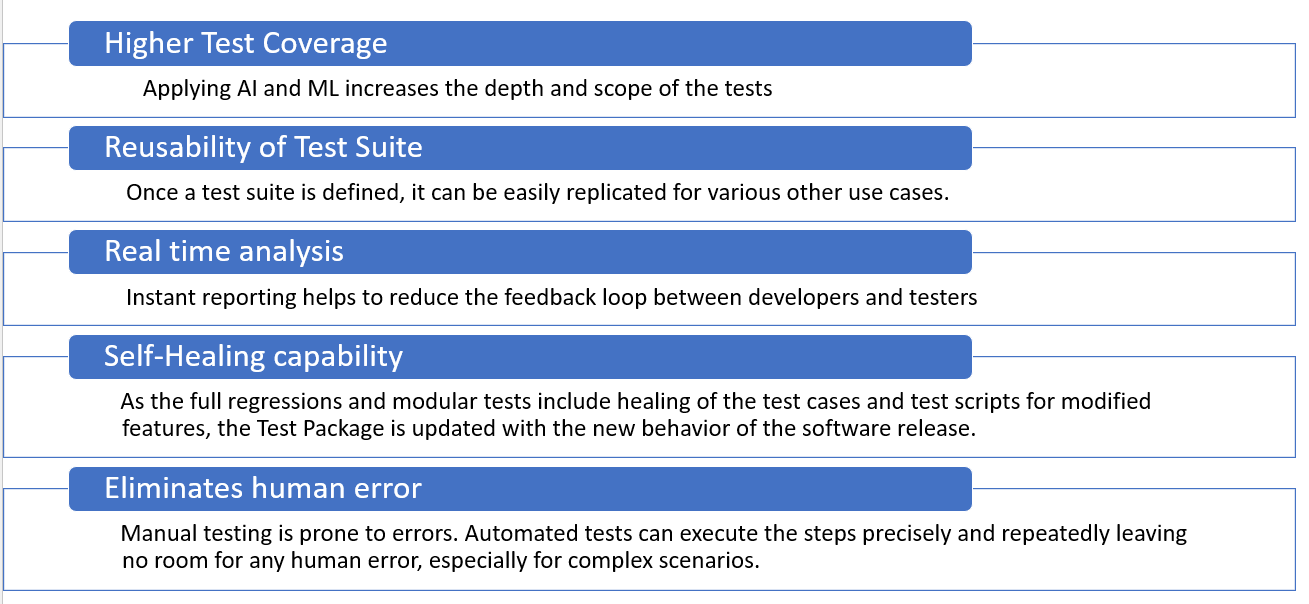
AI-powered Automated Test Case Generation results in:

Getting the test plan and test strategy right is an important step of testing and at the heart of effective testing lie test cases – they are indispensable for ensuring high quality, reliable, and user-friendly applications. We have talked in detail about “Understanding Test Plan and Test Strategy for Effective Test Automation” in our blog published last week. Click here to read more.

Now, let’s look at the key considerations in selecting the right tests to automate.

Step 1 – Identifying the right test cases

A test case is a well-defined specification of inputs, test procedures, test conditions, and expected output. They are designed to uncover defects and vulnerabilities in the application, validate the applications works as intended, and meet performance standards. 

Pro Tip: Understand why Modularity in test case writing is critical

To ensure overall test coverage, you need a well-rounded set of test cases that address various aspects of the application. 

For example:

  • Test cases to assess the overall user experience
  • Test cases which impact the functionality 
  • Test cases to verify how the application handles unexpected errors and exceptions.
  • Test cases for verifying the interaction between different modules of the application 
  • Test cases which may impact security and performance

But does that mean you can automate ALL tests?

Step 2 – Identifying the right test cases – TO AUTOMATE!

Now that the test cases have been identified, the next step is to execute them. That calls for the next level decision, which ones to be executed manually, and which ones to be done via automation.

The decision to automate or not should be based on various factors such as the testing objectives of the particular project, complexity, availability of skilled resources, and Return on Investment (ROI). Not all tests will meet these criteria. By carefully selecting the right tests for automation, teams can unlock a myriad of benefits, from increased efficiency and speed to enhanced test coverage and early defect detection.

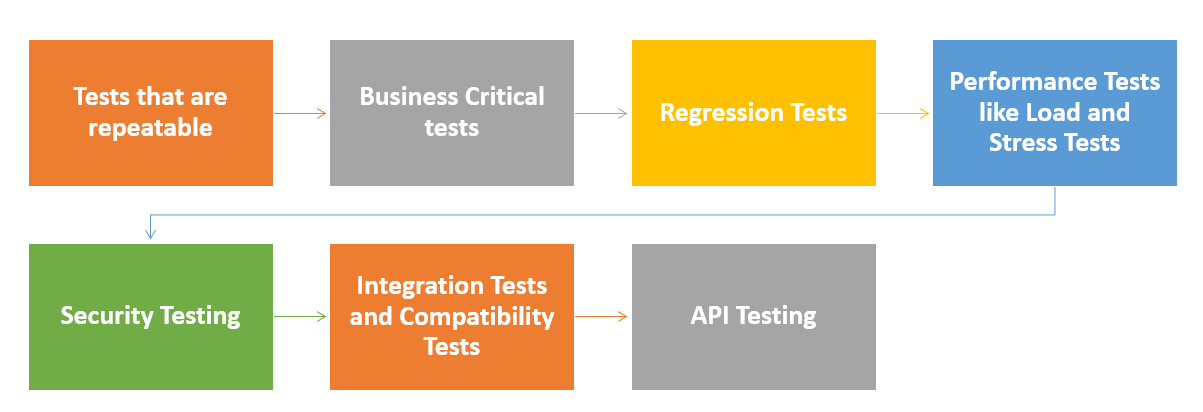
Tests that should be automated:

Tests that are repeatable – Tests that are run with each code change to ensure existing functionality remains intact.

Example: Let’s take an example of an online banking application. Automate tests for account verification or tests for repeated balance inquiries.

Business Critical tests – The features or modules that could cause damage to the business if they fail.

Example: Automate tests for complex loan approval or online bill payment scenarios involving various parameters and criteria.

Regression Tests: Tests that verify the functionality of the application after each code/build release. Read on to know What are the 3 types of Regression Testing and when to  use them?

Example: Automate bill payment module after each code update.

Performance Tests like Load and Stress Tests: Tests that simulate load and stress conditions on your application during heavy user traffic. Check this out to know more about the Performance Testing Types & Metrics

Example: Automate performance tests to evaluate the responsiveness of online banking services during peak hours or during tax filing months.

Security Testing: Tests to identify any vulnerabilities in the application. See how you can Add Security Testing with Complete Regression Test.

Example: Automate security tests to identify data security and web vulnerabilities.

Integration Tests and Compatibility Tests: Tests that verify compatibility across different browsers, devices, and operating systems.

Example: Automate tests to ensure that your banking application functions seamlessly on multiple web browsers and devices, and external systems like payment gateways.

API Testing: Tests that help to ensure the integrity and functionality of your application’s services. Also learn the 5 Traps to Avoid in API Testing and some Dos and donts of API testing.

Example: Automate API tests to validate the functionality of a banking application’s RESTful APIs for fund transfers or payments.

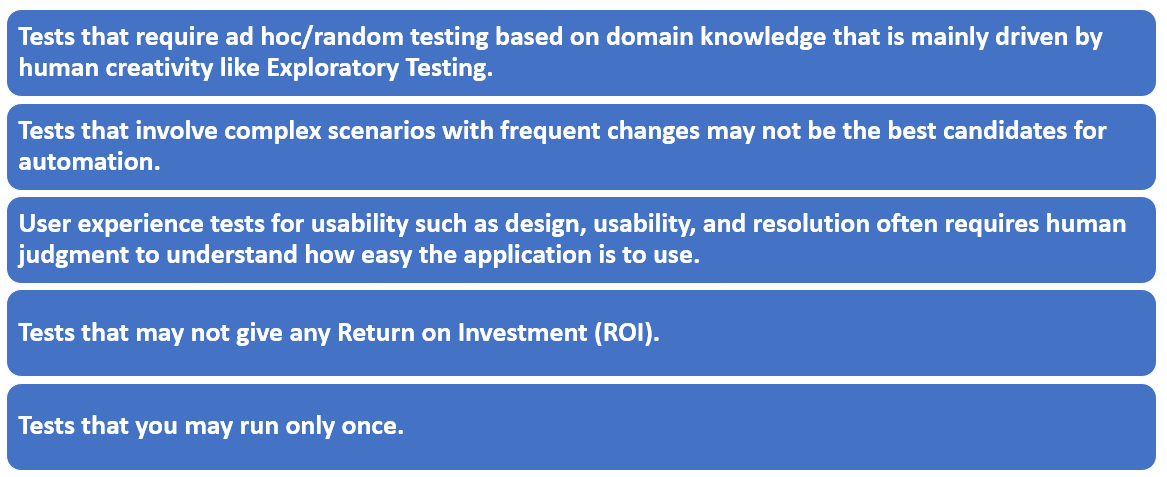
Tests that should not be automated

Though there are many benefits to automation, it’s important to recognize that not all tests are best suited for automation.

How Webomates does it

It’s the era of smart testing. And in today’s global competition, the ability to inspect the product quality comprehensively and reliably is a key success factor for organizations. 

Webomates’ powerful, patented CQ Portal uses advanced AI and ML algorithms and deep learning to produce actionable results from multivariate problems. 

Webomates offers regression testing as a service that is a combination of test cases based on testing and exploratory testing. Test cases based testing establishes a baseline and uses a multi-execution channel approach, to reach true pass / true fail, using AI Automation, automation, manual, and crowdsourcing.

Webomates Intelligent Test Automation helps to create test cases that are automatically generated from application models thus enabling Continuous Testing too.
If you are interested in learning more about Webomates’ CQ service please click here and schedule a demo, or reach out to us at info@webomates.com

AI Testing Services: Understanding Defect Leakage in Software Testing

  In today's fast-paced software development environment, organizations are under constant pressure to deliver high-quality applications...