Showing posts with label Intelligent Test Automation. Show all posts

Wednesday, December 13, 2023

How to pick the right test cases to automate


Testing the code…A battle against time!

Traditionally, manual testing has always been the cornerstone of quality control for software. However, it often proves to be time-consuming, error-prone, and limited in scope. These limitations become more and more evident as applications are now complex and release cycles are accelerated.

This demand for agility and efficiency led to the advent of automation, where there was an emphasis on speed, efficiency, and wider coverage.

As a result, most of the testing projects are trying to shift their focus on translating their manual test cases to automated ones to enhance efficiency, productivity, and overall testing coverage.

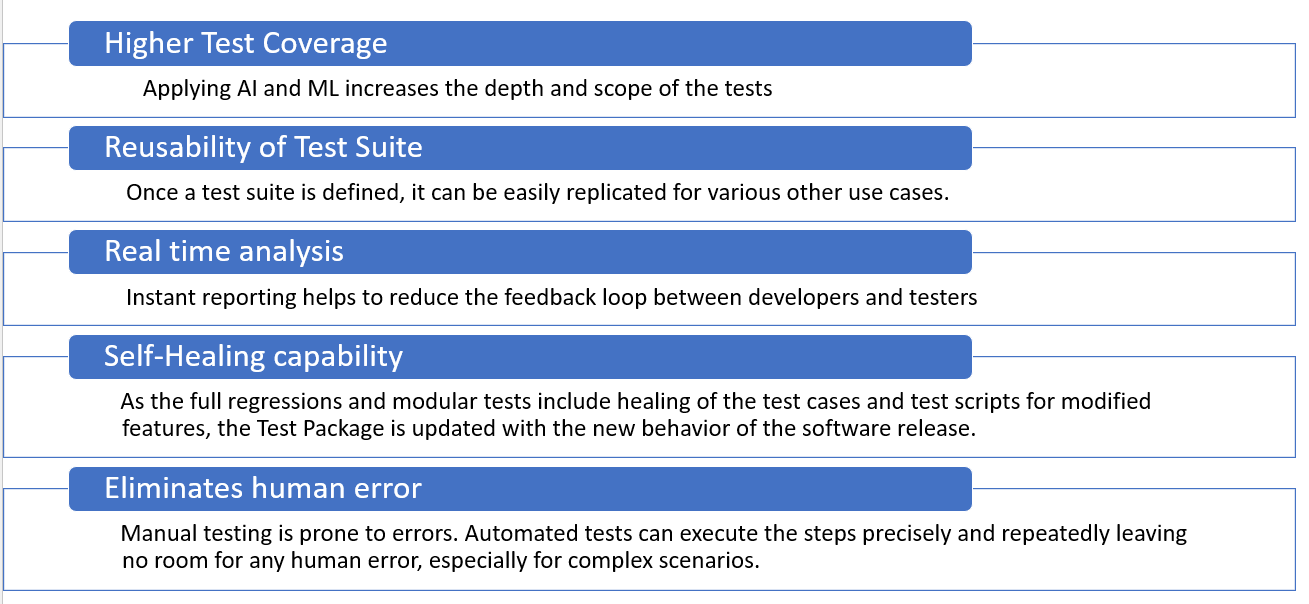
AI-powered Automated Test Case Generation results in:
Getting the test plan and test strategy right is an important step of testing and at the heart of effective testing lie test cases – they are indispensable for ensuring high quality, reliable, and user-friendly applications. We have talked in detail about “Understanding Test Plan and Test Strategy for Effective Test Automation” in our blog published last week. Click here to read more.

Now, let’s look at the key considerations in selecting the right tests to automate.

Step 1 – Identifying the right test cases

A test case is a well-defined specification of inputs, test procedures, test conditions, and expected output. They are designed to uncover defects and vulnerabilities in the application, validate the applications works as intended, and meet performance standards. 

Pro Tip: Understand why Modularity in test case writing is critical

To ensure overall test coverage, you need a well-rounded set of test cases that address various aspects of the application. 

For example:

  • Test cases to assess the overall user experience
  • Test cases which impact the functionality 
  • Test cases to verify how the application handles unexpected errors and exceptions.
  • Test cases for verifying the interaction between different modules of the application 
  • Test cases which may impact security and performance

But does that mean you can automate ALL tests?

Step 2 – Identifying the right test cases – TO AUTOMATE!

Now that the test cases have been identified, the next step is to execute them. That calls for the next level decision, which ones to be executed manually, and which ones to be done via automation.

The decision to automate or not should be based on various factors such as the testing objectives of the particular project, complexity, availability of skilled resources, and Return on Investment (ROI). Not all tests will meet these criteria. By carefully selecting the right tests for automation, teams can unlock a myriad of benefits, from increased efficiency and speed to enhanced test coverage and early defect detection.

Tests that should be automated:
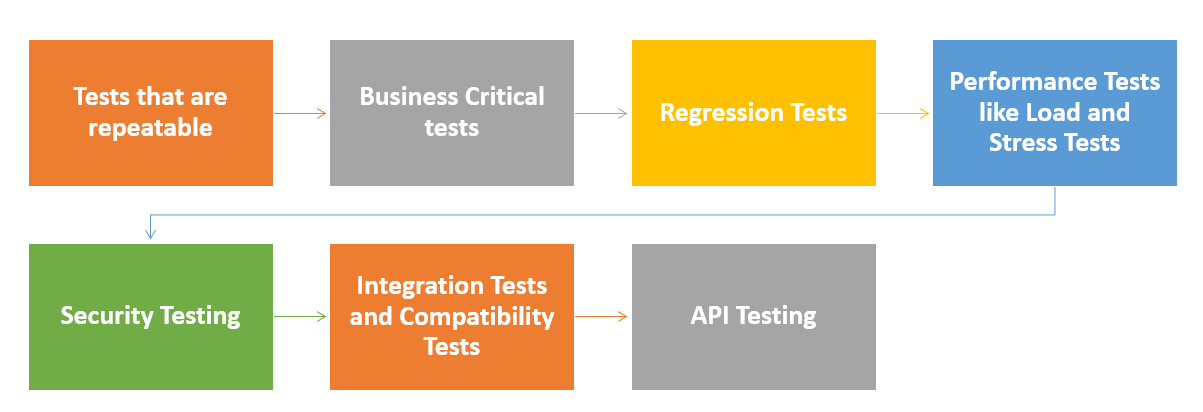
Tests that are repeatable – Tests that are run with each code change to ensure existing functionality remains intact.

Example: Let’s take an example of an online banking application. Automate tests for account verification or tests for repeated balance inquiries.

Business Critical tests – The features or modules that could cause damage to the business if they fail.

Example: Automate tests for complex loan approval or online bill payment scenarios involving various parameters and criteria.

Regression Tests: Tests that verify the functionality of the application after each code/build release. Read on to know What are the 3 types of Regression Testing and when to  use them?

Example: Automate bill payment module after each code update.

Performance Tests like Load and Stress Tests: Tests that simulate load and stress conditions on your application during heavy user traffic. Check this out to know more about the Performance Testing Types & Metrics

Example: Automate performance tests to evaluate the responsiveness of online banking services during peak hours or during tax filing months.

Security Testing: Tests to identify any vulnerabilities in the application. See how you can Add Security Testing with Complete Regression Test.

Example: Automate security tests to identify data security and web vulnerabilities.

Integration Tests and Compatibility Tests: Tests that verify compatibility across different browsers, devices, and operating systems.

Example: Automate tests to ensure that your banking application functions seamlessly on multiple web browsers and devices, and external systems like payment gateways.

API Testing: Tests that help to ensure the integrity and functionality of your application’s services. Also learn the 5 Traps to Avoid in API Testing and some Dos and donts of API testing.

Example: Automate API tests to validate the functionality of a banking application’s RESTful APIs for fund transfers or payments.

Tests that should not be automated

Though there are many benefits to automation, it’s important to recognize that not all tests are best suited for automation.
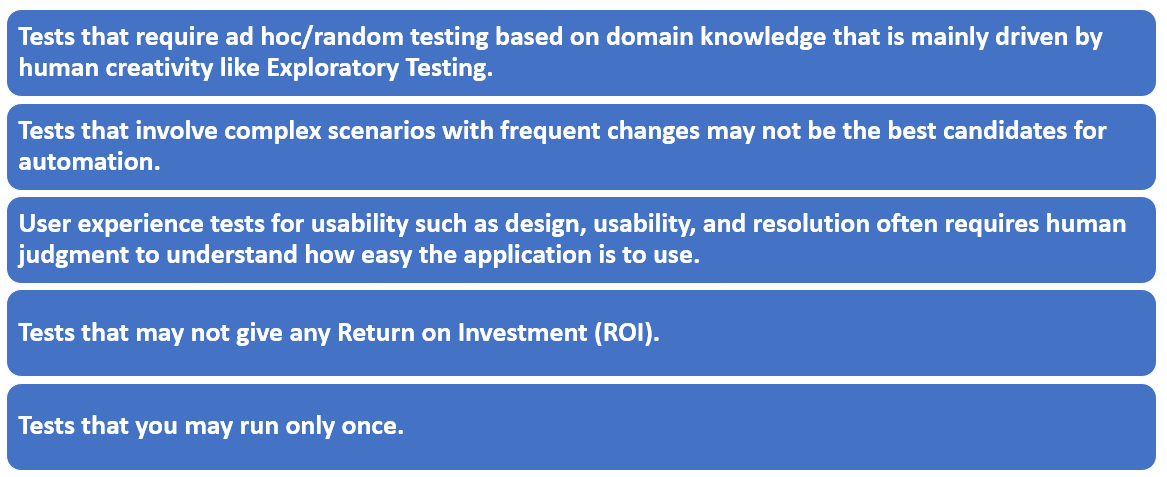
How Webomates does it

It’s the era of smart testing. And in today’s global competition, the ability to inspect the product quality comprehensively and reliably is a key success factor for organizations. 

Webomates’ powerful, patented CQ Portal uses advanced AI and ML algorithms and deep learning to produce actionable results from multivariate problems. 

Webomates offers regression testing as a service that is a combination of test cases based on testing and exploratory testing. Test cases based testing establishes a baseline and uses a multi-execution channel approach, to reach true pass / true fail, using AI Automation, automation, manual, and crowdsourcing.

Webomates Intelligent Test Automation helps to create test cases that are automatically generated from application models thus enabling Continuous Testing too.
If you are interested in learning more about Webomates’ CQ service please click here and schedule a demo, or reach out to us at info@webomates.com

Tuesday, November 21, 2023

Top 8 Intelligent Test Automation Trends To Look For in 2023

Intelligent Test Automation is the new fuel to software testing –  the use of Analytics, Artificial Intelligence, and Machine Learning makes smarter and intelligent decisions at a higher efficiency. To be future ready, you need to embrace innovative and intelligent trends and tools.

Now before we dive into the intelligent testing tools, we need to understand what are the latest trends in testing and why we need these.

This is the first article in the series that covers the trends, and then the second article covers the tools that will help us.

The Changing Landscape of Software Testing

From being a standalone activity at the end of the development cycle, Testing has come a long way and now it’s embedded throughout the software development pipeline. Time to market is a key imperative to succeed in today’s competitive world. Any tool can help you test your application, but there is more to effective testing than that. 

The future of effective testing is dominated by the recent technological advancements in Artificial Intelligence (AI), Machine Learning (ML) and insight-driven methods that help you right from the planning stage till execution. With rapid advancements in AI and ML, the future of testing is also evolving.

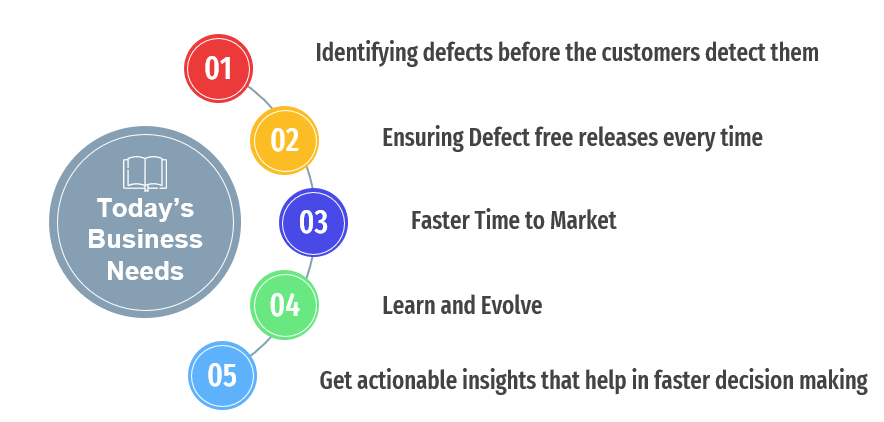
Today’s business needs

Today’s businesses have realized that using AI-ML powered Test Automation Tools have major impacts on the business outcomes, they are time saving and help you with faster and better quality releases. The trends and tools will help you and the business by:

Today’s business needs

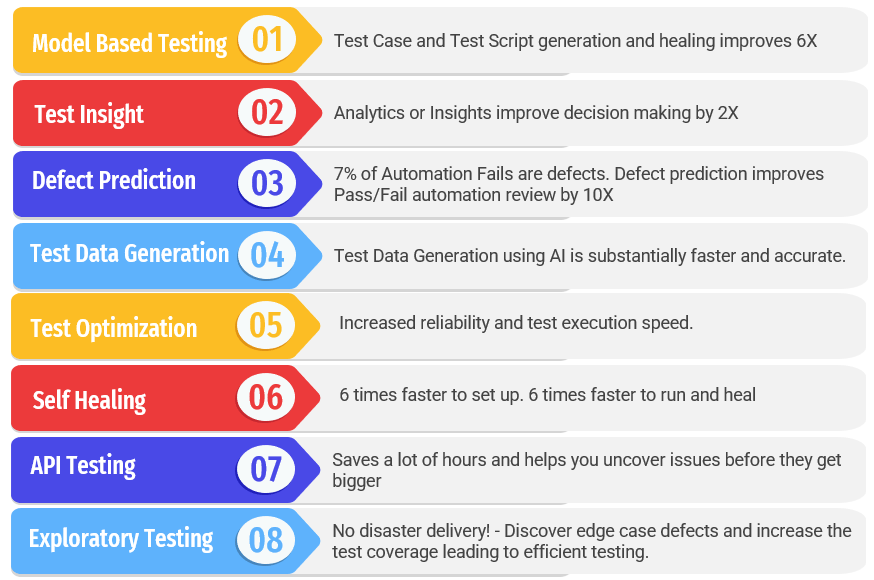
The current trends in AI Testing

Many organizations have made AI-driven transformations and are making significant progress in driving use cases at scale. In the sections below, we take the categories that Gartner depicts for employing Intelligent Test  Automation in QA testing. Additionally, we have also added three more areas to expand the overall scope of Intelligent Test Automation.

current trends in AI

Here are the current trends in AI testing that help deliver the business needs along with the delivery of flawless applications and enhanced user experience.

1. Model Based Testing continues to get better and better, decreasing the effort needed to create and maintain automation.

This is an application of model-based design where test scripts are automatically generated, executed, and checked based on formal specifications of the system under test.

Impact – Test Case and Test Script generation and healing improves 6X 

2. Test Insight is moving into mainstream and can help you shape and measure your testing efforts, quality and product life cycle.

They help you with test insights into the entire CI/CD pipeline to understand the impact every change is having on the product and provide guidance and strategic benefits to test management. 

Impact – Test Analytics or Insights improve decision making by 2X

3. Defect Prediction can help you save enormous amounts of time in diagnosing and triaging automation Pass/Fail.

Quality comes when you have proper defect triaging/reporting and no noise. The AI tools share an in-depth analysis of automation failures to help the teams reduce their triage time

Impact – 7% of Automation Fails are defects. Defect prediction improves Pass/Fail automation review by 10X 

4. Test Data Generation is the biggest challenge for ensuring an excellent testing process and many companies have been focused in this area and rapid advancements are being achieved. With the power of AI and analytics, you can generate data that comes as close as possible to your production data without revealing any sensitive information.

The AI based tools help you analyze a UI and identify a series of test cases that predict the user behavior. It also updates your test data based on newly added functionalities to the system along with the ability to identify and prioritize the test cases for execution.

Impact – Test Data Generation using AI is substantially faster and accurate.

5. Test Optimization is making the test process efficient without any quality compromises.

To speed up and optimize the testing in agile and DevOps environments, World Quality Report recommends a new option – the use of AI to optimize test cases.

AI systems are ideal for determining the area to test as well as the method to test and to failover.

Impact – Increased reliability and test execution speed.

6. Self Healing is the need of the hour as It helps teams to move from defect-based resolution to real-time issue resolution. It’s the ability to update the test cases and test scripts when the UI or API  changes.

The complexity of applications increases exponentially as new features are added to the existing functionality. The AI ML power combo can learn if there is a change made, and then automatically modify the test automation script to fix the problem.

Impact – 6 times faster to set up. 6 times faster to run and heal

7. API Testing is the latest trend in the testing community with organizations moving to cloud computing. as it emphasizes the testing of business logic, data responses and security, and performance bottlenecks. With teams moving to microservices architecture, the usage and testing of APIs are on the rise.

Impact – Saves a lot of hours and helps you uncover issues before they get bigger

8. Exploratory Testing has gathered momentum in recent years as it can help testers explore the application beyond the limits of scripted tests.

Exploratory Testing helps to reveal bugs that would go undiscovered during the structured phase of testing. It’s a simultaneous process where you can perform test design and test execution at the same time.

Impact – No disaster delivery! – Discover edge case defects and increase the test coverage leading to efficient testing.

Here’s an interesting whitepaper that talks about the software testing trends forecast and euphoria around Artificial Intelligence – Hype versus Reality. Along with the overall trends of Intelligent Test Automation that we just talked about, the paper dives into the insights and innovations developed by technologically dexterous companies and provides our estimate of the impact that using AI would have in the near term.


Conclusion

With applications becoming complex, teams often struggle with multiple challenges. For example, testing teams need to work collaboratively with the development team on every product release, identifying issues, and fixing them within timelines. With the world moving toward Agile and DevOps, the scalability to changing requirements becomes slow with inefficiencies and delays as teams lack necessary new-age technological skill sets.

With every organization embracing Artificial Intelligence and Machine Learning technologies, CI/CD model, Agile and DevOps practices across all domains, the push for high quality product releases through rapid release cycles are at an all time high. Hence, these next-generation trends are exceedingly important for teams and organizations to accelerate the testing process. 

Now that you are aware of the latest trends, let’s look at the innovative tools that will help you jump start your testing.

If this has piqued your interest and you want to know more, then please click here and schedule a demo, or reach out to us at info@webomates.com.

If you like this blog series please like/follow us Webomates or Aseem.

AI Testing Services: Understanding Defect Leakage in Software Testing

  In today's fast-paced software development environment, organizations are under constant pressure to deliver high-quality applications...