Showing posts with label AI Testing. Show all posts

Thursday, January 11, 2024

10 Lifesaving AI Uses Every Developer/Tester Should Know


Software and applications have become an integral part of every industry. According to Statista Market Insights, “The world software revenue was estimated to be around $659Bn in 2023.”

As good as it sounds, this major surge in software or application requirements has made it difficult for software teams to focus on quality and speed at the same time and this is when AI comes to the rescue. From driving high-performing software solutions to interactive applications, AI plays a very important role in the software development lifecycle.

According to this report from Market Research , the Software Quality Assurance Market is expected to register a CAGR of 9.6% and USD 14.01 billion by 2025. AI is one of the contributing factors to this growth.

This article focuses on how AI is helping developers and testers alike in making the software development process more efficient.

AI Use cases for Developers and Testers

Natural Language Processing for Requirements Analysis

According to an IAG consulting study, “Companies with poor requirements definition and management spend on average $2.24 million more per project on their major projects.”

In an Agile environment, it’s a daunting task to interpret ever changing customer requirements. This is when AI comes to the rescue by processing and analyzing product requirement documents with remarkable accuracy. AI-driven NLP algorithms extract essential information and can present the analysis in desired format, helping the teams comprehend project requirements more efficiently.

Code Review Assistance

Code reviews are crucial for maintaining code quality, but they can be time-consuming, if done manually. AI technology can help with code analysis, identify code quality issues, suggest improvements, and even automate some parts of the review process. This accelerates development cycles while ensuring higher code quality.

CodeScene, one of the top code reviewing tools of 2023 leverages AI to automate the entire process and provides instant feedback as well.

Continuous Integration and Continuous Deployment (CI/CD) Optimization

Efficient CI/CD pipelines are the backbone of modern software development. AI helps with codeless testing, offers better test coverage and also comes with a reliable defect management system. Apart from that it also offers fool proof tracing to debug efficiently.

Automated Test Case Generation

Manual test Case generation for multiple scenarios can be tedious and error-prone. Additionally, test case updation can be very challenging due to changes done to reflect bug fixes and incorporate new requirements. AI-based test automation saves time, increases testing efficiency, and reduces human error.

We at Webomates use generative AI extensively to accelerate our test case creation process thereby reducing efforts significantly. Want to know more? Read our blog “Generative AI is a game changer in Software Testing

Automated Performance Testing

Performance testing measures, validates and verifies response time, stability, scalability, speed and reliability of a system. AI can automate performance testing, simulating thousands of users and identifying performance bottlenecks. According to Dunn & Bradstreet59% of Fortune 500 companies have experienced 1.6 hours of downtime per week at the least. This has affected their revenue and brand reputation as well. Having AI based automated performance testing will prevent such issues and ensure smoother operation.

Security Vulnerability Scanning

Security is paramount in software development. AI can scan code for security vulnerabilities, including common issues like SQL injection or Cross-Site Scripting (XSS). Identifying and mitigating these vulnerabilities early can save both time and money.

Canva, a graphic design platform, has grown rapidly, and being a cloud company, it needed extra protection so that its tool wasn’t compromised, and this is when it deployed AI into its development process. This has helped them prevent some critical malicious attacks.

Predictive Bug Detection

AI can predict potential bugs in code before they become critical issues. By analyzing historical data and code patterns, it alerts developers to areas that may require extra attention. This proactive approach helps in delivering more reliable software.

Anomaly Detection in Production

In production environments, AI shines in detecting anomalies and issues. It monitors real-time data, identifying deviations from the norm and alerting operators when something goes wrong. This proactive monitoring minimizes downtime and enhances system reliability.

Capgemini has incorporated AI powered Anomaly Detection to identify any kind of deviations in the data logs during the development process.

Predictive Maintenance for Software

As per Webomates insights, “Software maintenance takes up 80% of the efforts and resources of an organization.” This is where self healing steps in. Self healing detects the changes in properties and automatically updates them with new attributes. This way, one can be assured that the designed test cases are functional.

Webomates took a step further and has incorporated our patented technology called AiHealing, which will address these errors without human intervention.

Automated Documentation Generation

Documentation is often an afterthought, but AI can change that. It automates the generation of documentation from code and tests, ensuring that software remains well-documented throughout its lifecycle. This benefits not only developers but also stakeholders and end-users. There are many tools available in the market for generating documentation from code like Docify, Mintlify, Docuwriter.ai and many more.

Conclusion

AI can simplify multiple tasks that are involved in the development lifecycle. Keeping up with the latest advancements is very important to ensure that you are ahead of the game.

If you are interested in transforming the way you have been testing and want to opt for a new, efficient, and faster process! Drop us a line at info@webomates.com.

Sunday, November 12, 2023

How To Calculate The ROI Of Test Automation


 Understanding ROI in Test Automation

In the era of data-driven decision-making, leadership rarely invests a single dollar from the business budget without having a clear grasp of the projected returns. Agile teams in particular find themselves in the limelight, having to present their work and explain why test automation should be used together with other crucial tools.

The benefits of test automation extend beyond testers. Test automation also benefits the developers within each feature’s team as they too take an active part in test automation. It involves using automated testing tools and scripts to execute tests, compare actual results to expected outcomes, and report test results. This approach offers a plethora of benefits such as increased test coverage, faster test execution, and early defect identification.

This article explores the significance of test automation along with the formula to calculate Return on Investment (ROI). Additionally, it lists a comparative table of benefits obtained from test automation.

The Formula: Measuring ROI

ROI is a critical metric that evaluates the effectiveness of an investment. When referring to test automation, ROI weighs the costs involved in implementing and maintaining automated tests against the benefits gained from improved testing efficiency and quality.

You can use the following formula to calculate ROI.

While there are various factors that contribute to ROI, you’ll need to understand the cost and time benefits associated with test automation to use the formula. Also, it’s just a metric that gives you the approximate return value you can get by embedding an automation strategy into your QA.

Calculating Time Benefits : A significant aspect of ROI is how test automation contributes to faster time-to-market. Calculate the time saved through automation in test execution, test case creation, and regression testing. Not only does automation improve testing efficiency, but it also frees up valuable resources for more strategic and creative tasks.

BenefitImpact of not using AutomationHow does Automation save time?
Enhanced ProductivityYour developers and testers can have effort burnout due to the mundane and repetitive tasksAutomation tool has the ability to work 24*7, 365 days a year, and at war speed. Tools like AI Defect Predictor tool can help them reduce their defect triage time.
Faster defect identificationTraditional testing is left at the end where you need to deal with a whole load of bugs and critical issues post-development.Shift Left testing provides an effective means to perform testing in parallel to development processes. Save enormous amounts of time in diagnosing and Defect Triaging 
Enhanced test coverageThe application can be exposed to invalid inputs, unusual conditions, or unexpected events that are not covered while designing the test cases.A combination of test cases-based testing, negative and edge case testing, and Exploratory Testing helps you increase the testing coverage, ensuring more comprehensive testing
Test Execution TimeTraditional testing will take weeks to execute and provide defect details to the development and testing teams.Execute automated tests by running a suite of tests
Test case creation timeCreating test cases manually is a repetitive, time-consuming process and may require frequent updates as the application changes. Create and maintain test scripts quickly compared to producing manual test cases 
Regression testing timeTest cases keep changing due to a defect fix or feature change. You need to validate these changes in every build. This creates immense pressure on your testing teams. Test automation can perform regression tests frequently and is carried out in 3 environments – Staging, Integration, and Development, to ensure that the existing application is not broken.

Calculating Cost Benefits : It’s important to account for all expenses related to automation. By assessing the potential cost savings, teams can make informed decisions about implementing the test automation. You can also consider both short-term and long-term savings, including reduced resoiurces costs and improved application quality.

BenefitImpact of not using AutomationHow does Automation save cost?
Initial setup costsThe expenses for acquiring tools, licenses, hardware, and infrastructure.Streamlining IT infrastructure management like setting up the servers, configuring them, deploying the applications, and managing the load helps in avoiding any issues in the scalability and availability of the application
Maintenance costsAutomation scripts and infrastructure need to be continually updated to keep your automation ecosystem up-to-date and efficientSelf-healing mechanism helps you to reduce Test maintenance by learning if there is a change made, and then automatically modifying the test automation script to fix the problem.
Cost of fixing escaped defectsPost-release defects can be expensive and time-consuming to fix.Teams can Shift Left to detect issues early in the testing lifecycle. By catching issues in pre-production testing, organizations can significantly reduce or eliminate defects. Fewer or no post-release defects result in cost savings related to bug fixes and support.
Infrastructure CostTeams need to perform manual configuration of individual deployment environments and this causes environment drift in the release pipeline.Infrastructure as Code (IaC) is the management of infrastructure using code files. The teams can test the applications in production-like environments early in the development cycle, preventing configuration drift and errors that surface after the release.

Keys Points to Consider

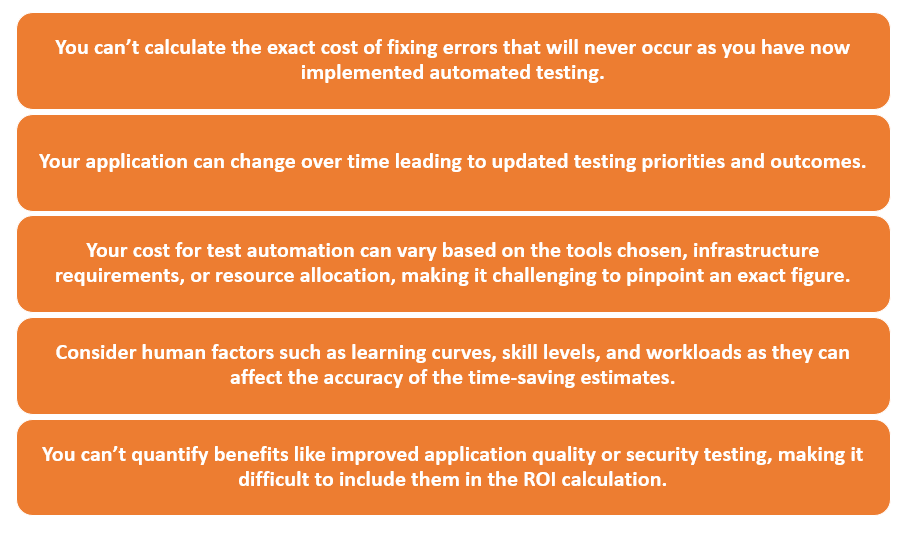
Before you start calculating, you should be aware that it is quite challenging to arrive at quantifiable metrics. You need to approach test automation ROI as an estimation rather than an exact number.

The Perks of Embracing Cloud Testing

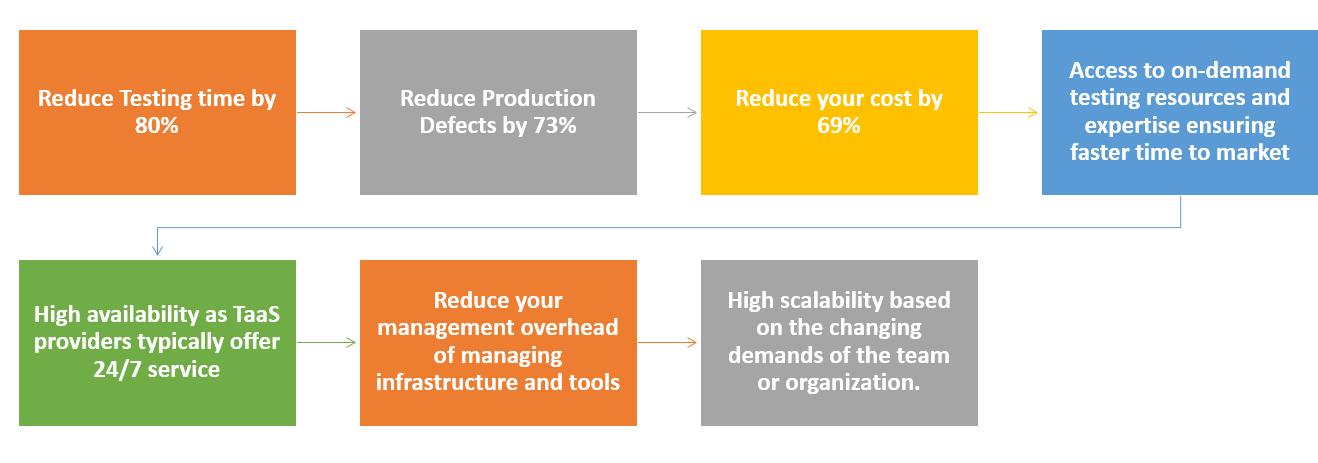
Testing as a Service enables the teams to focus on higher-value priorities like defect resolution and quality analysis. It creates test cases and test scripts and keeps them up-to-date. 

Unlike traditional testing, cloud-based testing resources can be dynamically scaled up or down as per the project’s requirements. In a time when software development workloads can be unpredictable and differ greatly between different projects, this adaptability is crucial. Overall, adopting cloud testing can result in better quality, faster time-to-market, cost savings, and higher efficiency for your applications. 

Partner with Webomates to get maximum ROI by implementing these principles.  

Connect with us to discover how you can redefine and transform your software testing with Intelligent Automation services. 
If you are interested in learning more about Webomates CQ service please click here and schedule a demo, or reach out to us at info@webomates.com

Wednesday, November 1, 2023

Best AI Test Automation Tool For Agile


Navigating Testing Challenges for New Ventures with Webomates CQ

As easy as it may sound, starting a new venture, especially when it comes to application development and testing, is filled with multiple challenges and roadblocks. New infrastructure, new development and testing tools and technologies, new partnerships, new customer segments, unknown costs — this complex terrain is uncharted.

Testing Challenges for New Ventures

Customer preferences are ever-changing. And new ventures must be agile and scalable in order to guarantee good user experience. That means, your development and testing teams must be agile and quick to respond to feedback.

Some of the common challenges faced by new ventures are:

  • Low Production Quality: Working on new feature developments in a short sprinted Agile framework and releasing them to the end users with limited regression translates to False sense of Quality — leading to usability and customers’ dissatisfaction.
  • Limited resources: Due to limited budgets and smaller teams, the quality of testing could be compromised.
  • Time constraints: A rush to release features quickly can lead to inadequate testing.
  • Lack of expertise: End-to-end testing requires domain experts
  • Lack of scalability: Automation does not automatically scale with growth
  • Testing Tools and Infrastructure: Acquiring and managing the testing tools and infrastructure can be very expensive leading to budget constraints.
  • Lack of Continuous Testing: Implementing testing in line with a fast-paced development cycle can be a significant challenge.

Rethink your business with Webomates

When competition is fierce, your success depends on your level of innovation and time to market. So, how can teams make the most of today’s unique opportunities, while mitigating the accompanying risks?

Cloud testing has become an urgent imperative for creating a sustainable advantage for teams, as it can ensure resilience, faster customer feedback, speed, and overall cost reduction.

Our goal…

Making sure applications don’t just ‘work’ but are defect-free and deliver seamless user experience.

Our Solutions…

Explore how high-impact intelligent test automation solutions can enhance your processes and boost your team’s productivity.

Your benefits…

Webomates comprehensive portfolio of solutions and services is designed to help you rethink the complexity of modern testing and unlock new levels of performance, like:

Features that help Webomates stand out among the Automation Testing Tools/Services are:

  • Modern Testing

Having attained the AWS DevOps competency status helps Webomates embrace DevOps. Its Continuous Testing solution helps accelerate your team’s feature velocity and ensure rapid and frequent quality releases.

  • Test case-based testing with exploratory testing

As test case-based testing follows a predefined script, there are chances that a bug may not fall in the script’s scope. When you combine the strengths of exploratory testing on top of test cases, you expand the scope of the test ensuring you uncover all defects.

  • Quick Regressions

Each release of a new product or enhancement to an existing release increases the complexity of testing and effective regression testing can greatly mitigate the business risk.

  • AI Healing

Did you know that 80% of the testing time goes in maintaining the automation? Our patent pending AI-Healing uses AI and ML algorithms to dynamically adjust their behavior based on the changing environments. The system can identify the false positives and also self-heal the false positives without human intervention and run the test within the same cycle. Remarkably, this entire AI healing healing process takes just hours, not days or weeks. And the automation is always up to date.

  • Accelerated Feature Velocity

Feature velocity gives an indication of how fast new features can be added to a product. Story points to measure the team’s current and expected deliveries. Automating the test case generation and execution process allows testing teams to focus on more critical and complex test scenarios, thereby increasing the team’s feature velocity.

  • Smart and Auditable Reporting

Our smart reporting includes detailed testing results and comprehensive analysis along with actionable triaged defects. This provides the stakeholders with a deeper understanding of the testing results, making it easier to make data-driven informed decisions and prioritize actions.

This is particularly useful across industries with strict compliance requirements, such as healthcare or finance, where a clear audit trail of all testing activities is necessary for regulatory and compliance purposes.

Client Success Stories

Our scale of collaboration and testing capabilities enable us to address vulnerabilities quickly or prevent them entirely. We have 9 patented AI tools and human expertise always at hand to help you. We have helped our esteemed clients achieve tremendous benefits by implementing these solutions.

  • We helped Rackspace Technology, Inc. test 14 IT applications on browsers, mobile, and API. They observed a remarkable 90% reduction in year-over-year production defects, coupled with an impressive 11-fold increase in feature velocity.
  • We enabled TMRW to begin testing the MVP of its Automated Cryo Specimen Management Platform for IVF. The auditable reports generated by our platform facilitated the achievement of FDA approval for their product.
  • Webomates has successfully completed SBIR Phase 1 and Phase 2 with the US Airforce, by demonstrating the ability to help organizations achieve scalability and agility while overcoming the typical traditional testing bottlenecks.

Take the first step, make the move!

Despite recent major advancements in AI technologies, only a few teams have made use of them. Adopting AI and ML-powered automation solutions will drastically transform your operations because they offer such a wide range of benefits related to Intelligent Automation.

AI is there to help you increase your efficiency! Introduce your team to AI Testing for improved efficiency and speed up your software delivery!

Please reach out to us at info@webomates.com to learn more about our AI-powered software testing solutions and how it can help you improve your business outcomes!

Tag: AI test automationAI TestingArtificial IntelligenceAutomation TestingBest AI test automation tool

AI Testing Services: Understanding Defect Leakage in Software Testing

  In today's fast-paced software development environment, organizations are under constant pressure to deliver high-quality applications...