Wednesday, January 19, 2022

Software Testing


What is software testing?

Software testing is a procedure, in which every one of the stages like test planning, test development, test execution, result investigation, tracking of bug and reporting are accomplished effectively.

Validation and verification of Software is software testing in software engineering.

Testing is a critical segment in the software development life cycle particularly with bugs and imperfections being boundless and phenomenal.

Software Testing is a continuous procedure and it ought to be conducted all through the development to guarantee that the application functions as per the expectations.

Software Testing as a Process

Software testing is a comprehensive procedure that incorporates connected processes. Three things you check through these procedures: Software completeness in regards to functional necessities; discovering errors that are technical in nature and guaranteeing the software is without bug; evaluating ease of use, execution, security, localization, installation and compatibility.  

The software can go overall, in segments, or within a live framework. However, if a product needs to be useful, it needs to go through every one of the tests. After every step of testing, the software goes for amendments. Subsequent to settling these mistakes, the software testing team again runs the following series of tests. This cycle proceeds until the point where the software reaches the desired level of quality.

Role of Metrics Reporting in Software Testing

Metrics in software testing can be characterized as standards of measurement. Software metrics are utilized to quantify the nature and quality of the project. In simple words, metrics is a unit utilized for describing an attribute. Thus, the metric is a scale for measurement.

Some example of Test Metrics

  • Test Execution summary – Pass vs Fail vs Blocked %
  • Defects per module
  • Test Coverage percentage
  • Defects by Priority
  • Requirement to test case traceability  

What is Software Test Measurement?

Software testing measurement is the quantitative sign of degree, amount, capacity, dimension or size of some attribute of a certain process or product.

Let’s take a brief look into what software testing is all about with the assistance of 5 Ws (Who, What, When, Where and Why) and 1 H (How).

5Ws and 1H explained through a project management-based scenario.

Taking a Software testing in software development project, for instance, we consider a situation where development team has discovered that technology they are utilizing isn’t completely perfect with the current frameworks of their client, as was already thought. So the task team can consider utilizing 5Ws 1H (or 2H) to comprehend the problem and its degree of impact.

Application of the first W – ‘’What”

What do the users do? What are the objectives they have to achieve? You have to understand their tasks all in all and also the assignments that relate to the software testing or framework that you’re planning.

Usefulness Vs Performance Vs Load Vs Security Testing (What)

An imperative assignment for testers is to confirm if the application complies with its determinations and necessities. Utilizing either Manual or Automated software testing philosophies, testers would need to test the applications UI, the APIs, the systems networking to guarantee that the application functions in the manner in which it is required to.

Testers do not just need to guarantee if the application can deal with a lot of information they also need to validate that numerous users are going to access the system. Software performance testing is done to benchmark the application performance in certifiable conditions and to recognize the bottlenecks that can block performance.  

In this regard, the testing team can make the following questions to create an understanding of the crucial problem and extent of the problem.

  • What is the technology we are utilizing for software testing development?
  • What technologies were considered at first for this development project?
  • What was known about the current system(s) of the client?
  • What checks and confirmations were done to affirm the similarity of the technology being manufactured and the arrangement compatibility of new technology on existing client system(s)?
  • What (assuming any) affirmed or unapproved adjustments/changes have been made after dialogs on technology similarity since the beginning of the task?
  • What expertise is accessible to the team to enable them to comprehend the similarity problem?
  • What are the acknowledged procedures for overseeing similarity and technological collaborations?
  • What rules or standard operating procedures (SOPs) are accessible to manage such problems?
  • What actions were taken once the problem was detected during testing?

Application of the second W ‘Why’

The task team may ask ‘Why’ questions to get a more granular comprehension of the problem and look to clarify triggers or drivers that may have added to the problem. A portion of the questions for software testing that can be asked are:

  • Why has it happened that two technologies are currently observed to be inconsistent?
  • Why was this problem not detected before or toward the beginning of the software testing or project?
  • Why technologies can’t be made good?
  • Why were quality affirmation forms not ready to recognize the problem?
  • Why were project teams or specialists engaged with the task not ready to identify the problem?

Application of the third W “When”

Test-First or Test-Last (When)

Software testing can either be composed before the code is finished or after the code is finished. Test-Last help in checking that the code fills in obviously while Test-First recognizes how the code should function. Composing the test initially has its very own favorable circumstances despite the fact that it might appear to be variant. It keeps imperfections and bugs from entering the code and later aides in outlining.

Test-Last help in checking that the code fills in of course while Test-First recognizes how the code should function. Composing the test initially has its own points of interest in spite of the fact that it might appear to be atypical. It keeps imperfections and bugs from entering the code and later aides in outlining.

By utilizing ‘When’ questions, project teams can time stamp the events and comprehend the connections among different events that may have affected the rise of the incompatibility problem.

  • When the problem or need for software testing was originally identified?
  • When was client system(s) information/architecture assessed?
  • When were similarities problems mapped and examined?
  • When any similarity tests were done and similarity was discovered satisfactory?
  • When was any incongruence affect appraisal done?
  • When was the problem taken up with client or client educated?

Application of the fourth W “Who”

Who are the users? What are their characteristics? What learning and experience do they convey to their tasks? Are there any other groups of users? Assuming this is the case, what separates them from one another, and which client bunches are generally vital? The subject of whose desires to meet dependably emerge. Would it be those of the Developers or of the Users? Users and engineers have their very own assumptions regarding the application and the codes. The desires from the two sides during software testing ought to be weighted legitimately. The project team can make questions to distinguish the people involved in contributing to the particular problem. A few questions that might be inquired:

  • Who is in charge of guaranteeing technological similarity within the project team?
  • Who is in charge of data gathering and client system(s) mapping on task team side?
  • Who is in charge of plan and change administration endorsements?
  • Who is in charge of giving client system(s) data and specialized points of interest to the task team from the client side?
  • Who is in charge of regulating the similarity of software testing and detailing?
  • Who is in charge of problem identification and acceleration?
  • Who is in charge of problem firefighting and contact?
  • Who detected the problem or came to know the problem first and who were educated first?
  • Who heightened the problem and educated the concerned parties?

Application of the fifth W “Where”

By asking ‘Where’ questions, the project team can improve the handle of the source(s) of the problem. A few questions that can be inquired during this stage of software testing are:

  • Where is the client system(s) found?
  • Where is development teams found?
  • Where is quality confirmation for software testing found?
  • Where is documentation on framework similarity kept?
  • Where are any endorsement/change administration documentation on framework engineering and similarity kept?

Now Application of the H “How”

In the metric reporting of 5W and 1H, anything that disappoints the client is a defect, thus understanding the client and client prerequisites is the most critical problem in building up a metric reporting software testing culture. This is a critical thinking administration philosophy that can be connected to a business procedure to recognize and take out the main drivers of defects within software development, eventually enhancing the key software features and sparing expense for the association. In such a manner, the fundamental objective of metrics reporting is that any software development in an association should be monetarily suitable.

5W and 1H metric reporting is a management logic, enables an association to apply a restrained, information driven methodology that consistently acquires development process execution by lessening the inconstancy in every software design. This makes a culture in an association went for figuring out how to fabricate forms that convey the business yield with immaculate quality. Metrics reporting additionally centers on estimating and controlling the variety at each phase of software testing and its development.  

To comprehend the sequence of differences between related events, the project team can ask how to addresses the 5W’s, for example –

  • How did the problem occur?
  • How has the succession of occasions prompted the discovery of the problem?
  • How are similarities problems dealt with and enter exercises detected in the task?
  • How are similarities documentations arranged, shared and put away?
  • How is similarity testing performed?
  • How the capability of inconsistencies limited and superior comprehension is assembled about mechanical similarity?
  • How are jobs and duties inside task portrayed and how is responsibility guaranteed?
  • How is detach between project teams limited and legitimate correspondence kept up?

You May Like to Read

Read for more : Software Testing

Our CQ portal provides metrics reporting which benefits the software testing of your software build. If you are interested in learning more about Webomates’ CQ metrics reporting please click on the link and schedule a demo.

Benefits of Intelligent Automation

 Artificial Intelligence is a technique that enables a computer system to exhibit cognitive abilities and emulate human behavior based on pattern recognition, analysis, and learning derived from available data with the aid of predetermined rules and algorithms.

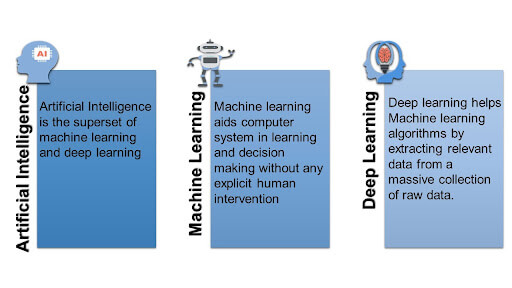
Machine learning and deep learning are two terms that are often used every time Artificial intelligence is discussed. People tend to use these interchangeably, however, there is a fundamental difference between them.

Understanding the fundamental difference between AI, ML, and DL

fundamental difference between AI, ML, and DL

Artificial intelligence is the superset of machine learning and deep learning.

Machine learning is a subset of AI which aids computer systems in learning and decision making without explicit human intervention. It works on pattern recognition technology and works with predefined algorithms to understand, learn, process, infer and predict, based on past data and new information. Its prime focus is to aid in decision-making. AI improves as ML improves.

Deep Learning is a subset of machine learning, also called scalable machine learning. It helps machine learning algorithms by extracting zeta bytes of unstructured and unprocessed data from data sets.

What makes intelligent automation important in software testing

Test automation promised to revolutionize the world of testing when it was first perceived and implemented. It delivered on that promise by improving overall testing speed and results. However, as technologies and processes further evolved, there was a need for improving the testing process too.

If you want to understand the journey of the testing process from manual to AI era, then read our blog “Evolution of software testing”.

Automation eased the testing load, but it could not “think”. For instance, test automation can execute thousands of test cases and provide test results, but human intervention is needed when it comes to deciding which tests to run. Adding the dimension of intelligence can add analysis and decision-making capability to test automation.

Intelligent automation works on data like test results, testing metrics, test coverage analysis, etc., which can be extracted and utilized by AI / ML algorithms to identify and implement an improved test strategy for efficient testing.

As per the Gartner study, “By 2022, 40% of application development (AD) projects will use AI-enabled test set optimizers that build, maintain, run and optimize test assets”

Let us explore further how intelligently automating the testing process helps in improving overall QA operations.

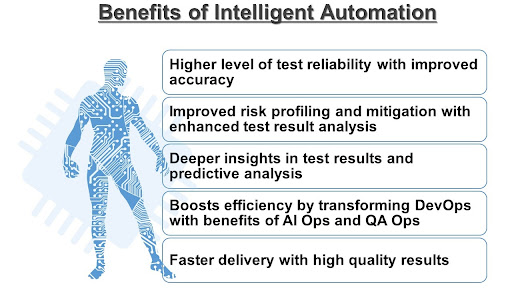
test reliability with improved accuracy
  • Higher level of test reliability with improved accuracy
    In the era of DevOps with frequent and shorter development cycles, continuous testing is conducted for every minor/major change or a new feature.  While test automation has helped a lot in reducing the testing burden, adding AI to automation can enhance the overall testing process, since it keeps evolving based on new information and analysis of past data. It also aids the teams in identifying the tests for better test coverage.
    With intelligent automation tools doing a large portion of recurring tedious tasks, the developers and testers can focus on other aspects like exploratory testing and finding better automation solutions.
  • Improved risk profiling and mitigation with enhanced test result analysis
    Intelligent automation renders the ability of risk profiling to testing.
    Intelligent automation and analytics help the testing and development teams to have a better insight into the impact of code changes and risks associated with those changes. Appropriate actions can be taken based on these insights and issues can be intercepted much earlier
  • Deeper insights in test results and predictive analysis
    Test reports and analysis are critical processes of software testing. It helps the teams in understanding the loopholes in their current test strategy and consequently aids them to define better strategies for the next test cycle.
    AI-infused tools can analyze and understand the test results, spot the flaws and suggest the workarounds. These tools constantly learn and update their knowledge base with every test cycle, based on test result analysis and apply that knowledge to improve software testing by detecting even minor changes and predicting the test outcome.
    Improved defect traceability and prediction is a game-changer when it comes to optimizing the test strategies.
  • Boosts efficiency by transforming DevOps with benefits of AI Ops and QA Ops
    To match pace with dynamic software testing demands, DevOps has to be augmented with the power of artificial intelligence. QA Ops have gained importance in the past few years and enabling it further by using intelligent automation will ensure faster time to market with better quality.
  • Faster delivery with improved results
    Intelligent automation plays an important role in accelerating releases since it optimizes the whole testing process based on a comprehensive analysis of previous test results. Continuous testing for frequent changes can be time-consuming, but AI/ML expedites the whole process by identifying the right set of tests to be executed, thus saving a significant amount of time and resources.

Read More about : Intelligent process automation

If this has picked your interest and you want to know more, then please click here and schedule a demo, or reach out to us at info@webomates.com.

We have more exciting articles coming up every week. Stay tuned and like/follow us at


LinkedIn – Webomates LinkedIn Page


Facebook – Webomates Facebook page


For More Information visit us at : webomates.com

Tuesday, January 18, 2022

Selenium Automation won’t get you to DevOps

 Manual Testing is evergreen. However, the zest to expedite the testing process and reduce human intervention paved the way to Automation testing 20 years back and AI Automation is now becoming the need of the hour. Who doesn’t love continuous delivery? With an aim to achieve collaboration across teams, integrate customer feedback on the go, and target small but incremental rapid releases, more and more teams are going the Agile DevOps way. Continuous delivery is the ultimate goal, and Continuous testing is the way to achieve it. 

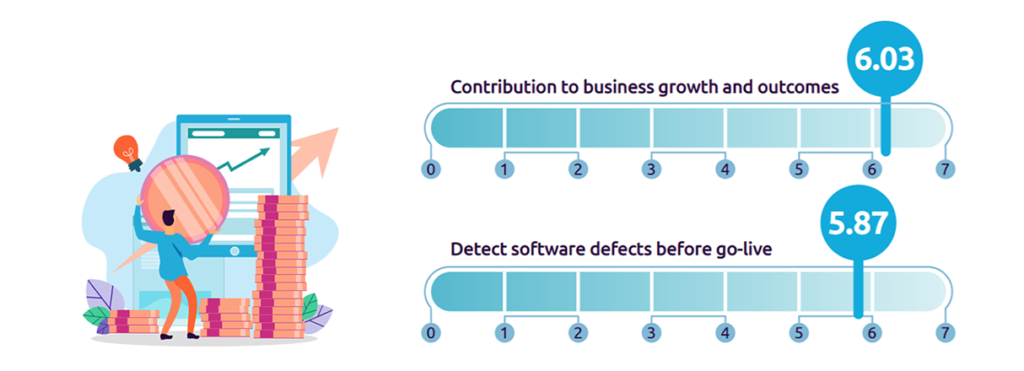
The 11th edition of the World Quality Report decodes the role of software quality in assuring business growth and outcomes. As per the report, test automation is the biggest bottleneck to deliver “Quality at Speed,” as it is an enabler of successful Agile and DevOps adoption.

Contribution to business growth and outcomes rated most important QA priority by IT and business

Continuous testing is the process of executing automated tests as part of the software delivery pipeline to obtain immediate feedback on the business risks associated with the latest build. 

It requires automated processes to achieve agility to build, test, release and deploy the software. Each build goes through Integration testing on the build server, Functional testing and regression testing on the test server, Deployment testing on the staging server. If the build passes, it advances to the next step. If it fails, it’s time to stop and fix the issue. 

How do you choose an automation tool for your team?

There are a plethora of open-source and commercial automation tools to choose from. You have IBM Rational Functional Tester, Test Project, Accelq to name a few. With such a broad range of tools available, organizations can find it daunting to choose the best one that conforms to their project requirements. However, Selenium is the most preferred tool. As per the HG Insights report, around 62,698 companies use Selenium. 

What is Selenium

Selenium is a free open source suite for automated testing for web applications across different browsers and platforms. Selenium focuses on automating web-based applications. You can use multiple programming languages like Java, C#, Python, etc to create Selenium Test Scripts. Selenium Software is not just a single tool but a suite of software, each piece catering to different testing needs of an organization. 

Selenium is considered among the top tools for browser-based and cross-platform regression testing due to the following factors:

  • It’s an Open source framework
  • Provides Multi-Browser Support
  • Multi-Language and Multiplatform support capability
  • Parallel and fast test cases execution

Sunday, January 16, 2022

Enhancing Test Automation with AI

 In an increasingly competitive market, there is a rise in demand to release software faster to meet the customer requirements, without any compromise in the end product’s quality.  This puts an additional load on the organizations to develop and test faster for quick releases. Continuous testing is an end-to-end testing process that speeds up the CI/CD pipeline, by incorporating automated processes and tools for testing early and testing often at all points of time. Test automation is an integral part of Continuous testing.

Test automation is a technique to automate predefined repetitive testing tasks, using various test automation tools and testing scripts. 

Test automation has marked benefits in terms of accuracy, scalability, dependability, enhanced test coverage, time and effort saving. But is it enough? Test automation eased the testing load, but it could not “think”. Augmenting test automation with the capabilities of AI introduced the dimensions of continuous learning, analysis, and decision making to the continuous testing process by emulating human behavior without any actual human involvement.

As per the recent study conducted by Gartner Inc., the business value of AI will reach $5.1 billion by 2025. In another study conducted by PwC, AI could contribute up to $15.7 trillion to the global economy by 2030.

Let us explore how embracing AI test automation improves the QA Ops process.

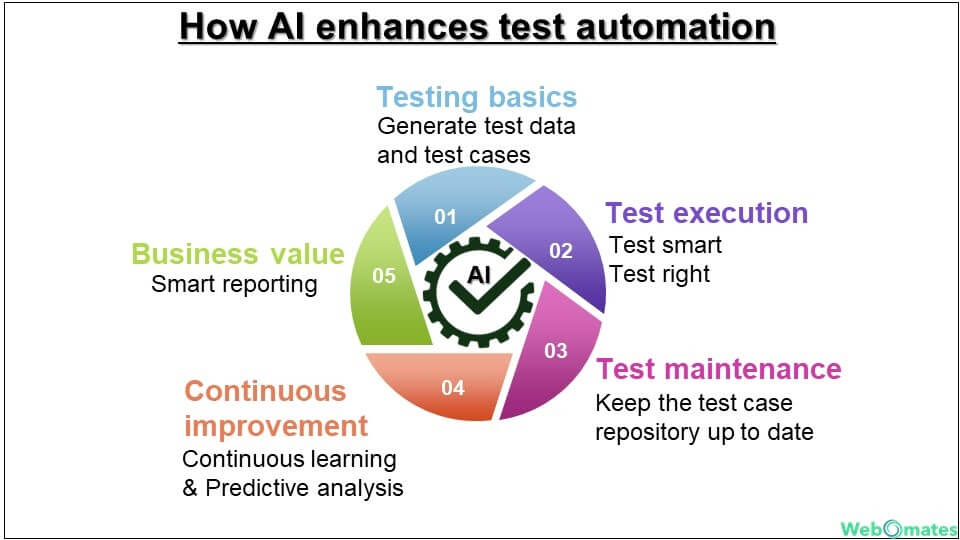
How AI enhances test automation

AI test automation, aka intelligent test automation, can spot anomalies, learn from patterns, analyze the data, and then if required, can update the test scripts to reflect the intended changes. This section explains how it does all this and takes testing to the next level.

test automation
Testing basics

Getting the basics right is a good start for the testing process. Test data generation and test case generation is an important task and needs to be done with utmost care.

Understanding, analyzing, and then translating the requirements to test cases is a time-consuming job. AI-based tools can do it for you in less time and you can redirect your effort for other tasks.

With continuous testing, the amount of data generated, aggregated over multiple cycles, is huge. Sifting through that data, analyzing the patterns and trends to act as feedback for the next cycle is a herculean task. Also, the input data and test cases need to be updated with every cycle and have to be in sync with the requirements. Using AI/ML shares the load and does the maximum job by generating test data and test cases by learning from previous data/reports and incorporating the new requirements.

Test execution
  • Test smart – It is not feasible to execute the whole test suite for the smallest of the changes made in the application under test. A smart strategy would be to identify the test cases that are directly impacted by the change and execute them. But with Continuous integration and testing, it becomes increasingly challenging to do that. Intelligent test automation comes to the rescue by analyzing the data from previous test cycles and identifying the right test cases to be executed for the changes done. This saves significant time and effort.
  • Test right – False failures are the bane of test automation. These are the scenarios when the test automation tool ends up marking a true pass case as a failure.  Do take out some time to read our blog “Test automation challenges – False failures” to understand this better.
    False failures can lead to unnecessary delays in the schedule because every failed test case needs to be triaged and based on its priority needs to be addressed accordingly. The issue of false failures can be addressed by applying AI/ML algorithms to test automation. The analytical capabilities of AI ensure that the test cases are marked correctly as true pass or true fail by learning from patterns of test results of previous test cycles and new information for the current cycle. Read for more : Test Automation with AI
  • Webomates has integrated solution Webomates CQ which helps companies to test the Mobile app properly and with effectiveness

Thursday, January 13, 2022

Software Testing Evolution & Methodologies

Software programming has evolved over the decades and consequently, testing, which is an integral part of software development, has also gone through a series of changes. 

It’s all started with programming and debugging phase, when finding errors during debugging was considered testing. In 1957, testing got an individual identity and was treated as a separate activity from the debugging process. Till the late ’70s, testing was seen as an exercise to ensure that the software works as per the specified requirements. It was then extended to find the errors, besides ensuring the proper functioning of the software. In the ’80s, the testing activity was also considered as a measurement of quality. With this, it gained more importance and was treated as a clearly defined and managed process of the software development life cycle.  By the mid-’90s, the testing process had its own life cycle.

In this article, we have segregated the phases of software testing evolution in terms of different eras for a better understanding.

The Era of Programmers and Testers 

Development and testing were treated as mutually independent activities during this era. Once the software was ready, it was passed on to the testing team for verification. Testers were not very actively involved during the requirement analysis phase and had limited interactions with business stakeholders. They were heavily dependent on the knowledge passed on to them via documentation done during design and development or gathering knowledge from developers who wrote the code. Lack of insight into the requirements and expectations of the customers led to limited testing strategies used by the testing team. The testers would develop a test plan based on their understanding of documentation and test the software in an ad-hoc manner. This obviously had certain limitations and the testing was not comprehensive.

The Era of Exploration and Manual Testing

The late ’90s saw the advent of various methodologies like agile testing, exploratory testing, etc. Testing was done manually using detailed test cases and test plans.

Exploratory testing gave freedom to test and break software in indigenous ways by exploring the software within the gamut of testing charters. 

Expansive and intensive growth of the software development process needed more comprehensive ways of testing. The incremental and iterative approach employed by agile testing helped in achieving this goal. Iterative way of testing paved way for automating the tests that were repetitive in nature. Read for more : Read for more click this link > Software Testing Evolution

Why Do Test Automation Challenges Slow Down Software Testing?

  Software testing is an essential part of delivering reliable and high-quality applications. As development cycles become shorter, QA teams...