Sunday, September 3, 2023

Generative AI in Software Testing — Webomates


Introduction

The landscape of technology is undergoing dramatic transformations, with Artificial Intelligence (AI) leading this monumental evolution. Among the concepts turning heads is Generative AI, especially its pertinence to software testing. Its potential to transform traditional testing approaches couldn’t be more timely, considering our rapidly evolving digital ecosystem.

Unlike traditional AI which recognizes patterns in the data available and predicts, Generative AI employs algorithms to develop fresh, unseen data based on learned patterns from an original source.

Advertisements
REPORT THIS AD

The process of training Generative AI models involves unsupervised learning where the model identifies patterns within unlabeled data, leading to vast and quick data generation, resulting in precise predictions and advanced customer personalization.
Here are some points highlighting how Generative AI is revolutionizing the tech landscape:

  • Content Creation: The emergence of AI has brought about a transformation in content creation especially when it comes to writing code. By leveraging machine learning techniques, it enables the generation of precise and fast code ultimately expediting project timelines and boosting overall productivity.
  • Customization: Generative AI algorithms excel at personalization by dynamically creating tailored customer offerings based on individual preferences and past behaviors. This level of customization surpasses immeasurably what was previously possible, enriching user experience while boosting engagement.
  • Enhanced Product Design: Leveraging generative design allows for innumerable iterations leading to optimized solutions that improve efficiency and usability while reducing costs.
  • Advanced Problem Solving: Employing generative models can help businesses generate potential solutions for complicated problems more extensively and rapidly than traditional approaches.
  • Data Augmentation: By generating new synthetic datasets, Generative AI assists in overcoming limitations imposed by inadequate or unbalanced information.
  • Security Enhancements: It can enhance security measures as its inconceivable behavior provides severe obstacles for cybercriminals aiming to crack coded patterns and systems.

By challenging traditional methods across various domains, including healthcare, cybersecurity, product development, digital marketing — and beyond — generative AI amplifies our ability to conceive possibilities pushing the envelope on technology’s capacity towards unimaginable horizons.

Understanding Generative AI — Roles and functions within this realm

Understanding Generative AI is like stepping into a fantastic sci-fi world where machines don’t just carry out instructions, they conjure up new ideas. Let’s have a closer look.

Advertisements
REPORT THIS AD

The roles and functions of Generative AI are varied and fascinating:

–Creator: Just as an artist uses a brush or a writer their words, Generative AI utilizes large datasets to create original content ranging from music compositions to full-fledged articles. It’s every creator’s trusted sidekick.

-Simulator: In need of testing scenarios but short on time? No worries! Simulate real-world situations with Generative AI for robust risk analysis or decision-making.

-Personalizer: Ever wished for your own personal stylist or movie recommendation? Your wish is Generative AI’s command! It tailors experiences based on individual preferences.

Different Generative AI tools in the market

Following are some Generative AI tools that are making waves in today’s digital landscape:

Advertisements
REPORT THIS AD

Google Bard is one of the latest projects released by Google, touted as their answer to OpenAI’s GPT-3. An innovative chatbot and content generation system, Bard heavily leans on LaMDA, a leading-edge transformer-based model that aims to foster more open-ended and natural conversations with machines.

Meta Llama2: Llama 2 created by Meta is a language model (LLM) that builds upon its previous version. This state-of-the-art technology has the ability to develop bots like ChatGPT or Google Bard. Its thorough training on datasets allows it to generate coherent and naturally sounding responses, with a human-like tone.

OpenAI’s ChatGPT provides an efficient human-like communication interface facilitating customer service operations but can occasionally misinterpret the context leading to irrelevant responses.Chatbots powered by OpenAI’s GPT, like ChatGPT, are revolutionizing the way we interact with technology. Using advanced machine learning algorithms and a vast database of language data, ChatGPT can generate relevant and contextually meaningful conversations.

DALL-E from OpenAI: Another impressive tool from OpenAI leveraging GPT-3 capability with image-generation models that produce unique images based on simple user-provided text descriptions. By taking simple text input, DALL-E can produce countless unique renditions of the described object or scene, demonstrating its unprecedented ability to combine disparate elements in creative ways.

GitHub Copilot is a cutting-edge AI-powered coding assistant launched by GitHub. It’s designed to help developers write code more efficiently. Using OpenAI’s Codex model, it predicts and offers suggestions for new lines or blocks of code, directly within the editor.

Potential Challenges of Generative AI

Some of the common challenges are listed below:

Advertisements
REPORT THIS AD

1. Misunderstanding User Intent: Understanding natural human language can be difficult due to its nuances, sarcasm, and slang leading to confusion or wrong responses.

2. Absence of Contextual Understanding: While GPT can produce coherent replies, it often lacks a deeper understanding of the context which humans provide naturally during conversation. This results in inaccurate responses.

3. Ethical Concerns: There’s the risk of producing harmful, inappropriate, or biased content as they base outputs on input data which may contain such biases.

4. Dependence on Data Quality: The performance of these models is reliant on the quality and quantity of training data. Garbage in, garbage out applies here too.

Addressing these needs continuous advancements in AI conversational models for better comprehension and contextual understanding. Enforcing strict ethical guidelines for AI usage and regulating training data meticulously is required to avoid learning from offensive content.

– Test case generation: Generates various potential scenarios for testing based on a wide range of input combinations.

Advertisements
REPORT THIS AD

– Test automation generation: Effortlessly writes scripts to automate repetitive and mundane tasks reducing human error.

– Test strategy updates: Constantly revises test strategies based on new updates or alterations in the project’s scope.

– Test case updates: Adapts generated test cases according to any modifications or new features introduced in app/software.

– Test automation updates: Keeps track of automated scripts for any changes needed due to system enhancements.

– Chat support to customers: Provides real-time responses to resolve customer issues promptly using language processing capabilities.

This revolutionary approach enables efficient bug detection at early stages thus improving overall product quality while saving cost and time.

Infusion of Generative AI in Webomates

Webomates is a pioneer in integrating Generative AI in software testing. With the continual advancements in Generative Artificial Intelligence, the technology has come to play an invaluable role across multiple phases of Webomates’ software testing process.

Test Script Generation Phase

Webomates’ AI engine executes a profound analysis of application workflows, followed by generating comprehensive test scripts that cover every notable functionality.

Advertisements
REPORT THIS AD

– Scalability: A considerable number of tests can be generated swiftly covering various facets with no manual intervention involved.

– Adaptability: Adapt to changes easily! Alterations need not worry testers as new test cases detecting these amendments get auto-created on-the-fly!

– Speed: Embracing Generative AI has brought dramatic improvements in speed of test case generation, while scaling back time, efforts and resources significantly.

Test Execution Phase

Webomates’ AI engine can automatically generate diversified and sophisticated datasets for testing purposes. These datasets have the capacity to replicate diverse and multiple real-world scenarios, the manual creation of which could be demanding and time-intensive.

– Random Data: The AI assists in creating random yet relevant data sets which can help check the system’s robustness against varying inputs.

– Edge Case Data: It aids in accelerating edge case validation by predicting situations that seldom occur but have critical implications if overlooked.

Test Case Maintenance Phase

Webomates’ patented AiHealing keeps the test automation always updated by regenerating the test cases within the same cycle, saving precious time and effort.

Embark on a High-Speed Testing Adventure with Webomates!

Advertisements
REPORT THIS AD

Generative AI could well be the game-changer we didn’t know we needed until now. So why not let yourself be swept away with progress and embrace these impressive advancements?

Are you racking your brain for expert testing capabilities with impressive turnaround times? Look no further; Webomates is here to sort you out. Our specialized service, Webomates CQ, presents you with the future of testing — Testing-as-a-service (TaaS).

Our TaaS utilizes the power of Generative AI to architect unique test strategies and test cases. We heighten the effectiveness through futuristic AI modules like Defect Predictor for speedy and precision-driven testing.

We resonate with the essence of your business operation, committed to enhancing app quality while amplifying cloud-based test results. Elevate your experience by teaming up with Webomates — because when it comes down to testing, nothing beats expert guidance.

Partner with us to steer your testing regime towards new horizons! Drop a message at info@webomates.com and someone from our team will reach out to you.

If you liked this blog, then please like/follow us Webomates or Aseem.

Read Next –

Adhoc Testing

Sanity testing

Advertisements
REPORT THIS AD

Chat gpt test automation

Api testing

Shift left testing

DevOps testing

Intelligent test automation

OTT media testing services

Requirement traceability

Black box testing

Regression testing

Software Testing Life Cycle

Test Automation vs Manual Testing

Selenium Testing Automation

Exploratory testing in software testing


Friday, August 25, 2023

Top differences between Low Code and No Code Test Automation


With the adoption of agile and DevOps, there is an increasing need to scale the entire development process to facilitate faster releases. The success of any deployment depends heavily on business and technical teams working in tandem and leveraging the maximum potential of automation. Lack of coding expertise is one of the major roadblocks faced by organizations in their automation journey.

As per the World Quality Report 2021-2022, “A lack of coding expertise is a major challenge when it comes to automation.”

As a result, organizations are now increasingly opting for Low Code / No Code development and testing tools.

According to Gartner, “The worldwide market for low-code development technologies is projected to total $26.9 billion in 2023.”

Low-code test automation leverages the power of easy-to-use tools to enable developers/testers to automate the testing process with minimal coding knowledge.

With more involvement of business teams in the QA Ops, there was a need to have handy tools which required NO coding knowledge. That is when No-code test automation tools help.

No-code test automation involves using intuitive visual tools to enable business users to generate test cases with no coding knowledge. The test cases can be generated with the help of a visual interface.

Often, these terms are used interchangeably, but they are very different from each other in reality. The table below lists various aspects of differences between them.

Common benefits of Low-Code and No-Code test automation

As highlighted in the table in the previous section, both of them are cost-effective and efficient ways to improve quality while optimizing the testing process. They can be implemented quickly and can easily adapt to business needs.

Here is a list of benefits that are common to Low-Code and No-Code Test Automation.

These platforms bridge the gap between technical and business teams and help them collaborate better. The teams can now focus on the value and outcome of testing, leading to reduced test cycles and accelerated product delivery. However, it is vital to choose the right testing tools and services that can seamlessly integrate into the existing CI/CD pipeline and effectively automate testing with minimal or no human intervention.

Webomates provides Low Code AI testing services that work in 2 phases as shown in the figure below.

Test Script Generation:  Coding knowledge is no longer a hindrance when it comes to script generation. Our AI discovery and generation tool generates not only test scripts that are compatible with multiple automation frameworks but also human-readable test cases for review, making the test review process much easier. This saves precious time and resources.

Execution & Analysis:  Webomates’ AI engine effortlessly modifies(heals) the test cases, and re-executes them within the same test cycle. Additionally, it also eliminates any false failures to allow the teams to stay focused on defect rectifications.

In addition, test case maintenance is a hassle-free activity with us. Updating the test case scripts and maintaining them is no longer a herculean task, as the AI engine is responsible for doing it for you. Detailed defect triage reports and videos are shared across the board, making it easier for the teams to analyze and work on their strategies.

Webomates’ AI testing services come with guaranteed execution SLA.

If this has piqued your interest and you want to know more, then please click here and schedule a demo, or reach out to us at info@webomates.com. If you liked this blog, then please follow us at Webomates or Aseem.

Read Next –

Ad hoc testing

Continuous testing tools in DevOps

Functional Testing

Api testing

Shift left testing

DevOps testing

Intelligent test automation

OTT media testing services

Requirement traceability

Black box testing

Regression testing

Software Testing Life Cycle

Test Automation vs Manual Testing

Selenium Testing Automation

Exploratory testing in software testing

Tuesday, August 8, 2023

Driving Efficiency with Generative AI: Reducing Automation Efforts in Testing

 Today is just the beginning of Generative AI and its countless benefits. Generative AI applications such as ChatGPT, GitHub Copilot, DeepArt, and others have taken the world by storm by unleashing a wave of innovation, creativity, and productivity. We are now able to do tasks that were previously unimaginable.

Generative AI – Catalyst or Replacement?

Generative AI can mimic human capabilities to an astonishing level, raising fears about AI replacing humans. However, it’s important to understand that Generative AI will only empower humans and not replace them.

Leaders across organizations are realizing that they can actually unlock exceptional accomplishments by nurturing this collaboration between humans and Generative AI.

So what are the potential business benefits?

Generative AI is being used to create new and unique content, spanning across various domains like art, music, graphics, social media, and beyond. Let us explore some of the business benefits it can offer when used in the software engineering disciplines.

Generative AI Use Cases

Let’s consider a scenario where a software application is being developed for a banking platform and needs to be tested. Now, let’s see how Generative AI can help us reduce manual effort, accelerate testing cycles, and help us improve efficiency across the following use cases.(Generative AI in software testing)

  1. Test Case Generation

Generative AI can help in generating comprehensive test cases by analyzing the requirements and existing code of the application. You can also use it to cover positive and negative test cases and edge cases.

For the banking application example, it can generate test cases to cover various scenarios such as creating new accounts, making fund transfers between different account types, testing different transaction limits, and verifying balance.

  1. Code Completion

Imagine the amount of time developers can save if they could get recommendations and code snippets to expedite the coding process. Generative AI understands the semantics and structure of the existing code and thus provides accurate suggestions.

Examples include CodeAI and GitHub’s CoPilot. They use contextual understanding, trained models, and code repositories to generate code snippets, accelerating the coding process and aiding the developers in reducing human errors.

According to Mckinsey research, technology companies are already using Generative AI such as Replit which is being used by more than 20 million coders today.

  1. Test Data Generation

Thorough application testing requires a diverse range of test data to simulate different scenarios and ensure overall test coverage. Generative AI can help create realistic test data.

For the banking application scenario, it can generate sample customer account details, names, addresses, and other required test data.

  1. Code Optimization

The development teams work on applications that involve complex code and algorithms. Generative AI algorithms can analyze code and identify any performance bottlenecks. They can also propose code refactoring suggestions to enhance readability.

For example, it can identify inefficient algorithms or resources used in any feature that takes up the maximum CPU usage, and suggest alternative implementations that improve the execution speed. This simplification reduces the complexity of the code, making it easier to test and maintain.

  1. Defect Identification and Prediction

With Generative AI, it’s easier to identify possible coding errors or any deviations from the coding standards. By leveraging AI and machine learning techniques, it can learn from previous defects, detect patterns and also predict defects.

For example, Webomates’ AI Defect Predictor helps the development and QA teams that use CI/CD service to reduce their triage time. This proactive approach enables the development and testing teams to correct their code and reduces the overall effort required in automation testing.

  1. Generate Documentation

By extracting data from code, test cases, and other resources, generative AI can automate the documentation process. Developers and testers don’t have to spend their time manually updating and creating documentation, which saves them time and effort.

Accenture is testing the use of OpenAI LLMs to automatically generate documentation – for example, SAP configuration rationale and functional or technical requirements.

Limitations of Generative AI Capabilities

Although the software development and testing teams are opening up to using Generative AI in software testing, it still comes with a set of unique challenges and limitations.

How Can Webomates Help?

Generative AI is here. And as it keeps evolving, it will unlock new possibilities for improved efficiency and innovations. Meanwhile, we can leverage it to transform our application testing and automation efforts.

Webomates understands that AI-based software testing speeds up product releases and generates the promised business value. It’s an industry- and tool-agnostic solution to optimize testing in various scenarios.

Schedule a demo to discover the full potential of our AI-driven software testing solutions that can boost your business outcomes, increase productivity, and accelerate product releases. You can also reach out to us at info@webomates.com

Monday, June 26, 2023

Staying ahead of the game: Why Test Automation is a Must-Have in 2023

 What and Why of Test Automation in Testing Landscape

Today, Technology and creativity know no bounds. AI, once regarded as science fiction and used as plot material for Hollywood movies, has become a near-ubiquitous technology that is enhancing our daily lives in our workplaces, homes, and across industries.

The market has been inundated with a steady stream of new digital products. The latest innovations have taken the IT world by storm. You can ask complex questions to ChatGPT and receive eerily humanlike responses. You also have a program called Codex that can write computer code; just describe the kind of software issue you’re attempting to fix, and Codex will provide a code solution in the form of a line of code.

The software testing industry too has undergone significant changes in recent years, with test automation becoming increasingly essential for organizations to remain competitive and deliver high-quality software. Test automation has become increasingly important for several reasons, including the speed and complexity of software development, the need for increased efficiency and accuracy, and the limitations of manual testing.

According to GMinsights‘ most recent analysis, Automation Testing is now valued at USD 20 billion and is anticipated to grow at a 15% CAGR between 2023 and 2032.

In this article, we will explore why test automation is so important in today’s software testing industry.

Harnessing Test Automation as a catalyst for change

You cannot talk about the latest practices like DevOps, Continuous Delivery and Continuous Testing without the term Automation.

Applications may have defects in their usability, security, performance, or any combination of those factors. And the inevitable result of this will be a decline in market share, revenue, and customer loyalty. Test automation provides the necessary speed and scale to ensure that software releases are delivered quickly and with high quality, allowing organizations to remain competitive and meet the demands of their customers.

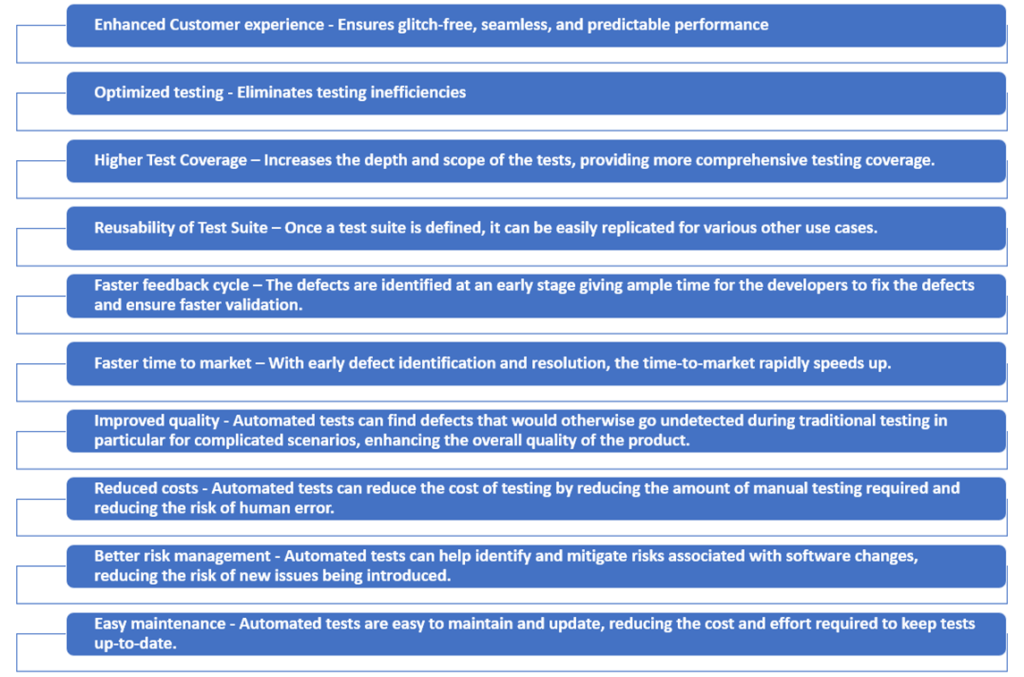
Reducing process lead time and costs through automation of labor-intensive, repetitive tasks frees up human resources for their core competencies and revenue generating tasks. Additional benefits also include:

Top Challenges for making the move to Test Automation

Organizations are realizing the immense potential of intelligent automation – how it increases value and efficiency across business processes. However, few teams are finding it a grueling task to make the move.

The Tricentis Software Fail Watch report states that 314 companies were impacted by software failures, affecting 3.6 billion people and costing $1.7 trillion in lost revenue.

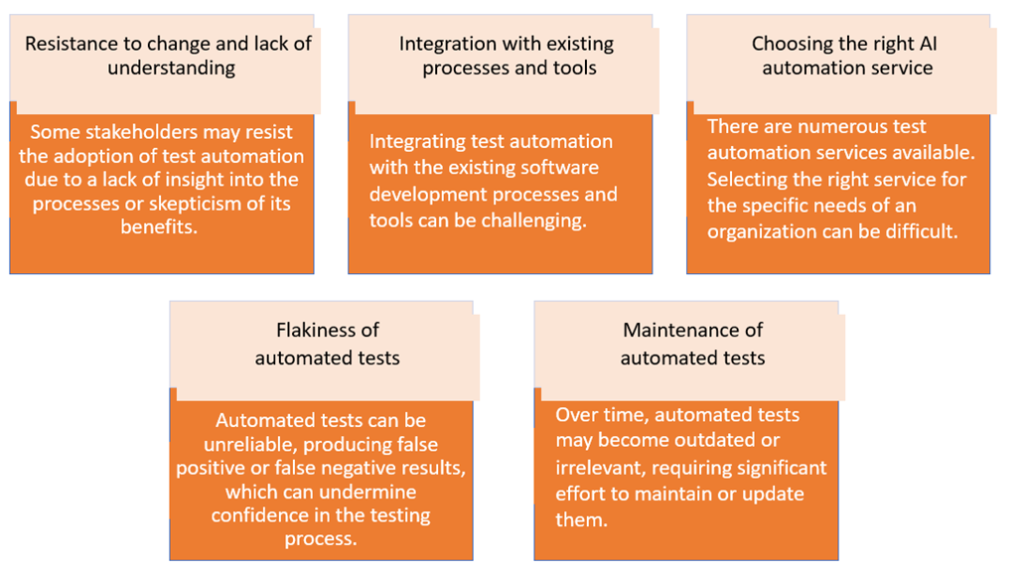
Test Automation has numerous benefits, but it comes with its own set of challenges:

So, how do we Implement a Good Test Automation Strategy?

Despite the fact that automation involves serious effort and dedication, success isn’t that difficult to achieve. The secret is to research, plan, and solve. One of the key needs for the industry is to provide the C-suite and organizations with a roadmap to accelerate, scale, and sustain automation testing adoption.

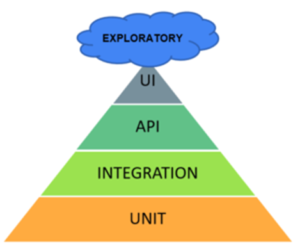
The Test Automation Strategy defines a framework for automated test scripts. It calls for automating tests at different levels. The foundation and bulk of this test automation pyramid are unit and integration testing. Service layer or API testing is the next step, where the API tests are run against the service layer.

The GUI tests, which are at the top of the pyramid, validate the application as a whole at the presentation layer. Top it up with exploratory testing that identifies potential edge cases. Unlike scripted testing, exploratory testing uncovers unique and out-of-scope defects that would have otherwise been missed.

Although implementing a test automation strategy requires significant time and resource commitment, the rewards can be enormous, including improved quality, lower costs, and greater efficiency.

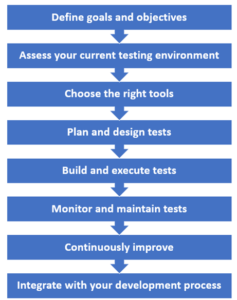
By following these steps, you can implement a successful test automation strategy that meets your specific needs and helps you achieve your goals:

  1. Define goals and objectives: Determine what you want to achieve with test automation and what benefits you hope to gain. Answer these 2 questions:
  1. Which are the features that need testing?
    This defines the area of the application which will be automated.
  2. What is the testing approach for each of the selected features?

Defining the scope will help keep all the teams on the same page.

  • Assess your current testing environment: Evaluate your current testing processes, tools, and infrastructure to determine what changes need to be made to support test automation.
  • Choose the right tools: Choose test automation tools that are appropriate for your specific needs and that align with your goals and objectives.
  • Plan and design tests: Plan and design your test automation approach, including how tests will be written, executed, and maintained.
  • Build and execute tests: Build and execute your test automation framework, including test cases and test suites.
  • Monitor and maintain tests: Monitor the results of your test automation, including test results, performance, and stability, and make any necessary changes to improve the tests.
  • Continuously improve: Continuously improve your test automation strategy by reviewing results, addressing any issues, and making changes as needed.
  • Integrate with your development process: Integrate your test automation strategy with your development process, including continuous integration and continuous delivery, to ensure that tests are run consistently and that results are available to stakeholders.

Types of Automation Tests

Depending on the project’s needs, the development process, and the testing effort’s objectives, different types of automation tests may be employed.

Let us look at the types of tests that can be automated and how they help test every aspect of the system enabling users to achieve a frictionless experience.

  1. Unit tests – These tests are used to verify that individual pieces of code, such as functions and methods, behave as intended.
  2. Integration tests – These tests verify how various components of the system interact with one another to make sure everything functions as it should. Integration tests may involve testing the interactions between different units of code, or between the application and external systems such as databases or APIs.
  3. Functional tests – functional tests validate the functionality of the system as a whole, from the user’s perspective, involving testing the UI, APIs, and other functional aspects of the application to ensure that they work as expected.
  4. Regression tests –  regression testing is re-running functional and non-functional tests to ensure that previously developed and tested software still performs after a change.
  5. Stress tests – Load on the networks results in server outages and network failures. To enhance user experience, stress testing is important to verify the performance on all pages.
  6. Performance tests – Performance Testing validates the performance and scalability of the system, including response times, resource utilization, and other performance-related metrics. It involves load testing, stress testing, and other types of testing to ensure that the system performs well under different conditions.
  7. Security tests – Security testing validates the security of the system, including testing for vulnerabilities, data breaches, and other security-related issues. Security tests may involve penetration testing, vulnerability scanning, or other types of testing to ensure that the system is secure. Read for More about :https://www.webomates.com/blog/staying-ahead-of-the-game-why-test-automation-is-a-must-have-in-2023/

Why Do Test Automation Challenges Slow Down Software Testing?

  Software testing is an essential part of delivering reliable and high-quality applications. As development cycles become shorter, QA teams...