Webomates provides a cloud-based AI software testing as a service platform to carry out software functional testing in guaranteed timeframes. The platform creates test cases & scripts and executes them using multiple testing execution techniques like AI Automation, Automation, Crowdsource & AI enhanced manual. At the end of the execution what you get is the actionable triaged defects. Every execution result is recorded and auditable from the CQ portal.
QA Ops is the next-level process ofDevOpsand is integral to the development and delivery operations. Its prime objective is to introduce quality from the onset of any project and ensure that all defined quality norms are followed throughout the development and delivery process.
QA Ops framework is the interlinking of three major processes of the development and delivery cycle — Quality Assurance, Development, and Delivery. This further implies that the concerned teams have to strive for continuous improvement to ensure that a high-quality product is delivered to the customers. Everyone involved from the conceptualization to realization of the application is accountable for maintaining the quality throughout the process.
The success of QA Ops is based on a higher level of collaboration and communication between all the stakeholders. The QA engineers need to work closely with the development team and operations team to decide on QA strategies and make sure that they are followed stringently.
The following diagram represents 4 key elements that need to be incorporated to embed QA in the core of operations.
Automation Automation accelerates the quality feedback loop, by creating, executing, modifying, and self-healing the test suites. Every build has to undergo functional testing, performance testing, and smoke testing, besides the customized set of tests specific for the module under test. Conducting these tests can be challenging if not conducted smartly. Intelligent automation can save precious man-hours and costs by fast-tracking the whole testing process.
Parallel testing Parallel testing involves executing multiple test cases on a module across various test setups in tandem, at the same time. Needless to say, these tests have to be automated for ideal parallel testing. Parallel testing is important to save time and accelerate the CI/CD pipeline by identifying any flaky tests. The involvement of all the teams ensures that these tests are immediately traced back to their origin and appropriate action is taken.
Scalability Scalability aids in determining the application’s performance under varying load conditions. QA Ops requires to have a test framework and infrastructure in place to conduct scalability testing as and when required.
Integrating development and QA with operations The QA team, the development team, and the operations team need to work together to define the whole QA Ops framework. Involving all the stakeholders from the beginning ensures that clear quality processes are defined from requirement understanding to delivery. Read for more click this link
The termartificial intelligencewas coined in the year 1956 at a conference at Dartmouth College, New Hampshire. Since then AI has seen certain ebbs, aka AI winters. It has been around for decades, slowly evolving.
The recent surge in the use of AI testing can be attributed to improved machine learning algorithms because of deep learning and the availability of massive data to learn from.
The Gartner Hype Cycle for Artificial Intelligence shares deeper insights on how artificial intelligence is making waves and impacting businesses worldwide. It also talks about how AI has found a niche place in top emerging technological trends.
In separate surveys conducted by McKinsey and PwC in 2020, artificial intelligence adoption can potentially contribute approximately $14-$15 trillion to the global economy by 2030.
Software testing has embraced artificial intelligence in its operations to address issues associated with manual testing. The rise of agile methodology and DevOps had initiated the need for shorter development cycles with faster time to market. Quality, of course, has to be the top priority. While many organizations have been working on AI automation for a while now, some are still sitting on the fence regarding its usage in their operations. This stems from the fact that certain challenges impede the adoption of AI-driven automation. Let us see what they are in the entailing section.
Business issues
Immaturity in adopting AI/ML: Integrating and leveraging the power of AI in QA operations has to be meticulously planned and should be a well-thought process. It is important to understand why and how AI will help in making the QA processes more efficient and cost-effective in the long run.
Lack of long-term strategy: AI strategies have to be defined keeping in mind long-term benefits. Expecting returns from the onset leads to disillusionment. The right approach is to involve all the relevant stakeholders- business, operational and technical, to define the strategy and invest initial time in selecting the right QA process and operation to automate. Aligning the automation goals with the quality assurance goals and defining measurable KPIs enables the stakeholders to define a well-rounded AI strategy.
Infrastructure issues: AI/ML solutions require high-end processors to cater to their need for high computational speed. With the exponential increase in the volume of data, the hardware and software scaling needs also change. The infrastructure requirements and costs associated with it are a big deterrent in AI adoption, especially for small and budget-conscious organizations. Cloud migration is a solution to this dilemma. Organizations can take advantage of a cloud computing environment with the power of parallel multiple processors without changing much in the in-house setup.
Integration issues with the current setup: AI-based applications require higher capacity hardware, making legacy systems redundant or incompatible with new versions. Besides this, introducing AI may require modifying the current software or in some cases, a complete overhauling of the system may be needed. This has a cost, time, and resources factors associated with it. Read More about : Api Testing
If this has picked your interest and you want to know more, then please click here and schedule a demo, or reach out to us at info@webomates.com. We have more exciting articles coming up every week.
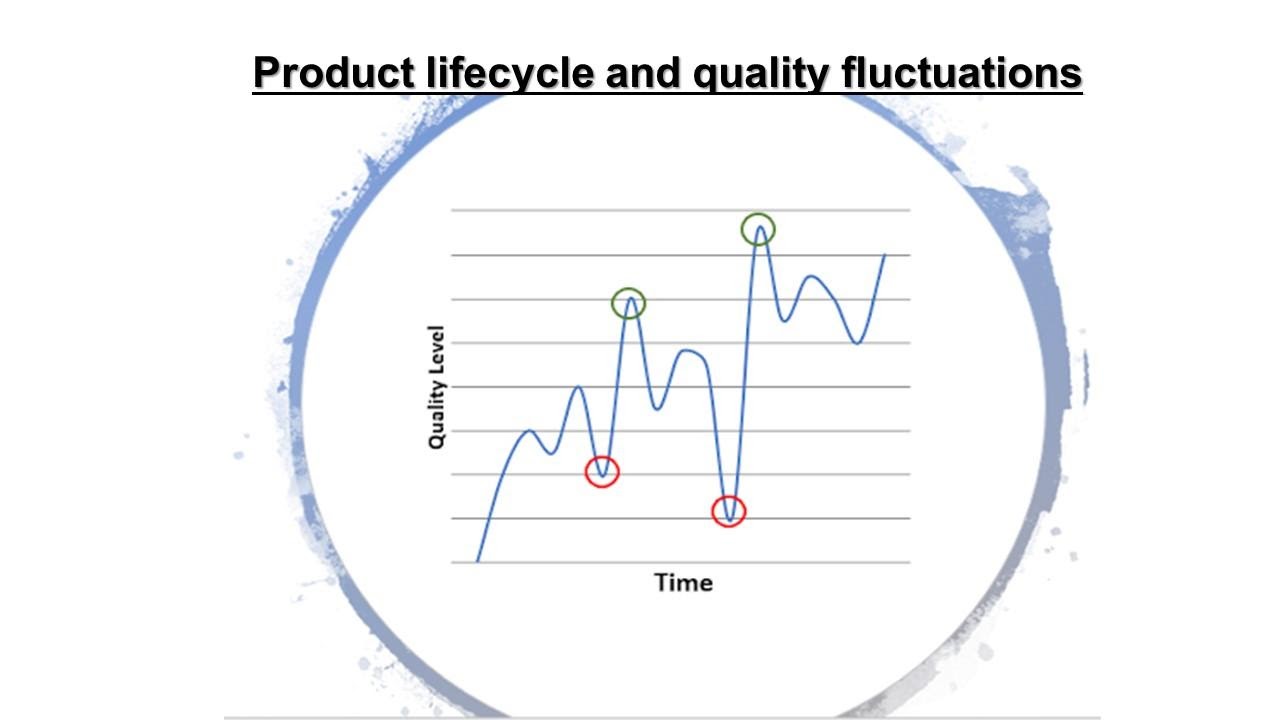
In the world of agile development, maintaining high levels of quality can become a major headache, due to its incremental and iterative approach. There are times when a time crunch may lead to certain compromises which allow a minuscule amount of defects to reach the deployment stage. Multiple releases of the product may not be at the same level of quality over a period of time.
Let us understand how it happens with the aid of the following figure, which depicts how the quality level of an organization can vary over time for a particular product or service.
The first red circle represents when the quality gets really bad. That mobilizes the teams and there is a concerted effort to improve and it leads to quality hitting the first green circle, i.e. significant improvement. However, if the organization’s QA process is not well defined, then the quality level starts dropping again once the crisis is over. Accrued technical debts lead to the second crisis point. Once again it triggers a reactive approach by putting in efforts for damage control which results in the second green circle in the above figure. And this cycle just keeps repeating till some concrete steps are taken.
However, the problem is that as the surface area of the product increases, that is, as many more features are created, over time the quality swings become larger in magnitude. Eventually, you reach a point where the only solution is to archive the current version of the product or service and create a brand-new version. It is also an opportunity to introspect and check if something is missing in the quality assurance policies and processes of the organization.
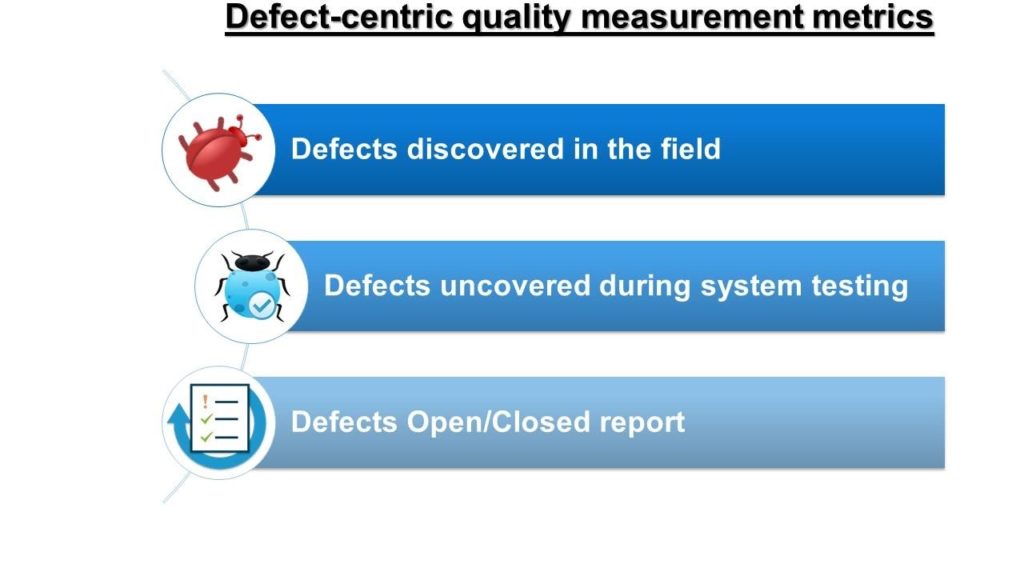
Ideally, the quality fluctuations should be managed by having well-defined strategies for testing and analyzing the test results. The next section covers three defect-centric metrics that can prove useful in quality measurement and assurance.
Defects discovered in the field
These are the defects found by users of the system and are reported back to the company. This metric sets the red flag because:
Defects reported in the field are very expensive to triage and fix
Users tend to report only severe defects
When you start seeing a lot of severe defects from multiple customers it is too late to pay your technical debts
This metric is an indicator of major quality problems within the organization’s QA operations. It triggers a red alert that the quality management process needs a major overhauling. The process team, development team, and the QA need to swing into action to identify where they are lacking and address the problem areas, or in some cases completely revamp the process. However, this can often lead to a crisis management reactive culture that oscillates from a major focus on quality to lackadaisical as soon as the customer crises are handled. Ideally, QA operations need to be set on a solid foundation of quality goals.
Defects found during system testing
This metric can be an excellent predictor of lurking quality problems. However, it requires consistent and intense software testing to be carried out on the product or service for every new feature or change.
If the number of priority 1 defects being found is increasing, or the net defects found are increasing, it means that there is a major problem and if not nipped in the bud, it can cascade further into a major catastrophe. Sometimes, these bugs indicate that there might be underlying issues that need to be identified and addressed before it is too late.Read More about :Ai testing
If this has picked your interest and you want to know more, then please click here and schedule a demo, or reach out to us at info@webomates.com. We have more exciting articles coming up every week.
Software programming has evolved over the decades and consequently, testing, which is an integral part of software development, has also undergone a series of changes.
It all started with ad-hoc testing by developers and testers, traversing through the era of manual and automation testing, to continuous testing which is integral for DevOps. The introduction of artificial intelligence in software testing opened doors for faster and reliable testing solutions which helped in delivering high-quality end products.
Read a detailed account of this journey on our blog “Evolution of software testing”. The focus of the current article is on how artificial intelligence is changing the face of software testing by accelerating DevOps.
10 ways to accelerate DevOps with AI
DevOps helps organizations in keeping pace with the market dynamics by building, testing, and releasing the software faster. Multiple build-test-release cycles generate massive data which is then monitored and analyzed for improvising the next cycle. It is difficult to sift through such a huge amount of data manually after every cycle, especially if the time is of the essence. DevOps augmented with AI is a perfect solution to improvise and speed up CI/CD/CT pipeline in a reliable manner. This is just one example where AI aids in increasing DevOps efficiency. There are more ways in which AI can help in accelerating DevOps, covered in the entailing section.
1. Codeless testing:
Codeless testing frees up the testing team from the tedious task of writing test scripts and makes way for them to focus on other important tasks. It not only increases efficiency by saving time and resources but also expands the scope of test automation.
We have covered the top benefits of codeless testing in our blog. Do take out some to read it by clicking here “Top 5 benefits of codeless testing”.
2. Better test coverage:
AI algorithms are equipped with the capabilities of diving deep into the massive volume of data at its disposal and identify multiple test scenarios that can expand the test coverage, which is a herculean task if done manually. It also uses its analytical capabilities to prioritize the tests based on predictive analysis.
3.Improved test accuracy and reliability:
Multiple release cycles in a short time involve executing a large number of test cases. While automation has taken this task from the tester’s hands, AI has gone a step further by improvising and evolving the testing with every testing cycle. This makes testing more reliable, efficient, and accurate.
Agile development leads to frequent changes in code due to defect rectifications and new/updated requirements. This consequently leads to changes in test cases. AI algorithms integrated with the test automation framework can understand these changes and effortlessly self-heal the tests and re-execute them within the same cycle, thus speeding up the entire testing process.
5. Effective defect management :
Defect management is an important aspect of software testing. Its scope is not limited to development and testing but also extends to defects encountered by the end-users when they use the system. Using artificial intelligence to troubleshoot and manage these defects significantly improves QAOps and DevOps. Read our blog “Intelligent analytics with AI testing” for further details.
6.Improved and foolproof defect tracing:
Defect identification, triaging, and tracing the defect to its origin is a key task of defect management. Defects can be introduced at any stage of development, right from conceptualization to any point till realization. Debugging and tracing is a time-consuming exercise. AI-based tools can perform this tedious task effortlessly.
7. Integrating predictive analysis with test results:
Testing result analysis enhances the software development process by identifying and aiding the teams in managing the flaws in their test strategies. AI-based testing tools constantly learn and update their knowledge base with every test cycle based on test result analysis, and apply that knowledge to improve software testing by detecting even minor changes and predicting the test outcome. It not only expedites the whole process but also makes it more intuitive and accurate.
Based on data collated from past test results and current test strategies, AI-based testing tools can mitigate risks by executing test cases for high-risk modules. This predictive analysis can optimize the testing process by a major degree. We have covered the test optimization aspect in our blog “How intelligent automation optimizes your testing”. Do spend some time reading it for better insights.
8. Enhanced test failure analysis:
Test failures are part and parcel of DevOps. It is important to manage these failures by analyzing them to understand the root cause and how it can be addressed to prevent such scenarios in the future. The AI model not only segregates the defects based on their priority but also analyzes the defect to understand the cause and notifies the teams accordingly. AI-based algorithms can understand the patterns and predict potential issues. These predictions aid the development teams to fix the issues before it is too late.
Coordination, collaboration, and communication are important cogwheels of the DevOps cycle. The test results and insights need to be shared with all the stakeholders, technical and business. It aids them in improving their business and technical strategies for accelerated development and delivery. AI helps the teams in staying updated with every aspect of testing. The test results are analyzed and reported to the stakeholders instantly. It helps in early intervention by the concerned team/person to address the issue.Read More about : Api Testing
If this has picked your interest and you want to know more, then please click here and schedule a demo, or reach out to us at info@webomates.com. We have more exciting articles coming up every week.
The value ofintelligent automationin today’s world is indisputable. It has emerged as a major disruptive force in the current digital landscape. Today, organizations need to generate increasingly AI-driven decision-making and end-to-end automated processes. That need gave rise to intelligent automation.
Today’s intelligent automation uses machine learning and AI to augment human capabilities to improve decision-making ability, user experience and efficiency.
Moving beyond RPA
With a focus on being both product anduser centric, the development and testing teams get involved in multiple areas. From developing new features to fixing bugs and architectural debt, managing CI/CD pipelines, and handling code repositories, the teams are under enormous pressure to stay focused on customer satisfaction and deliver quality.
Though RPA has a magnitude of benefits, it is somewhat confined to automating manual tasks and isn’t entirely focused on the end-to-end processes. That’s where AI comes in.
By using AI, ML, and end-to-end process automation, organizations can streamline processes that are otherwise composed of manual tasks, which are eventually resource-intensive, time-consuming and prone to human error, also yielding decreased defects in production and speeding up the feature velocity. Intelligent test automation encompasses a model-based approach to testing in order to generate and maintain test cases automatically. This also allows organizations to embrace end-to-end testing practices throughout their enterprise for broader test coverage, reduced maintenance costs, and more efficient test cases.
Advantages of IA Testing
When done right, Intelligent Automation opens the door to a wide range of business process benefits and delivers real benefits, including the following:
Faster and Smarter Releases with Webomates AI
So, are you ready to maximize efficiency and deliver value with seamless intelligent automation? Webomates infuses intelligence into systems and applications across the software development lifecycle to make your business more efficient and adaptable while delivering greater value. It adopts automation solutions to support developers to operate with quality and agility. Our solution focuses on the three intrinsic aspects of Quality-Time-Cost and helps in achieving the business objectives. It’s a one-stop solution for test management, test planning, test execution, and test reporting . Read More about : Intelligent Test Automation
If this has picked your interest and you want to know more, then please click here and schedule a demo, or reach out to us at info@webomates.com. We have more exciting articles coming up every week.